Enterprise AI Adoption Surges, But Foundations Lag in 2026
Enterprise AI adoption jumped to 72%, but only 18% of teams have the structured content foundations needed to scale it.
November 19, 2026 · 8 min read
Executive summary
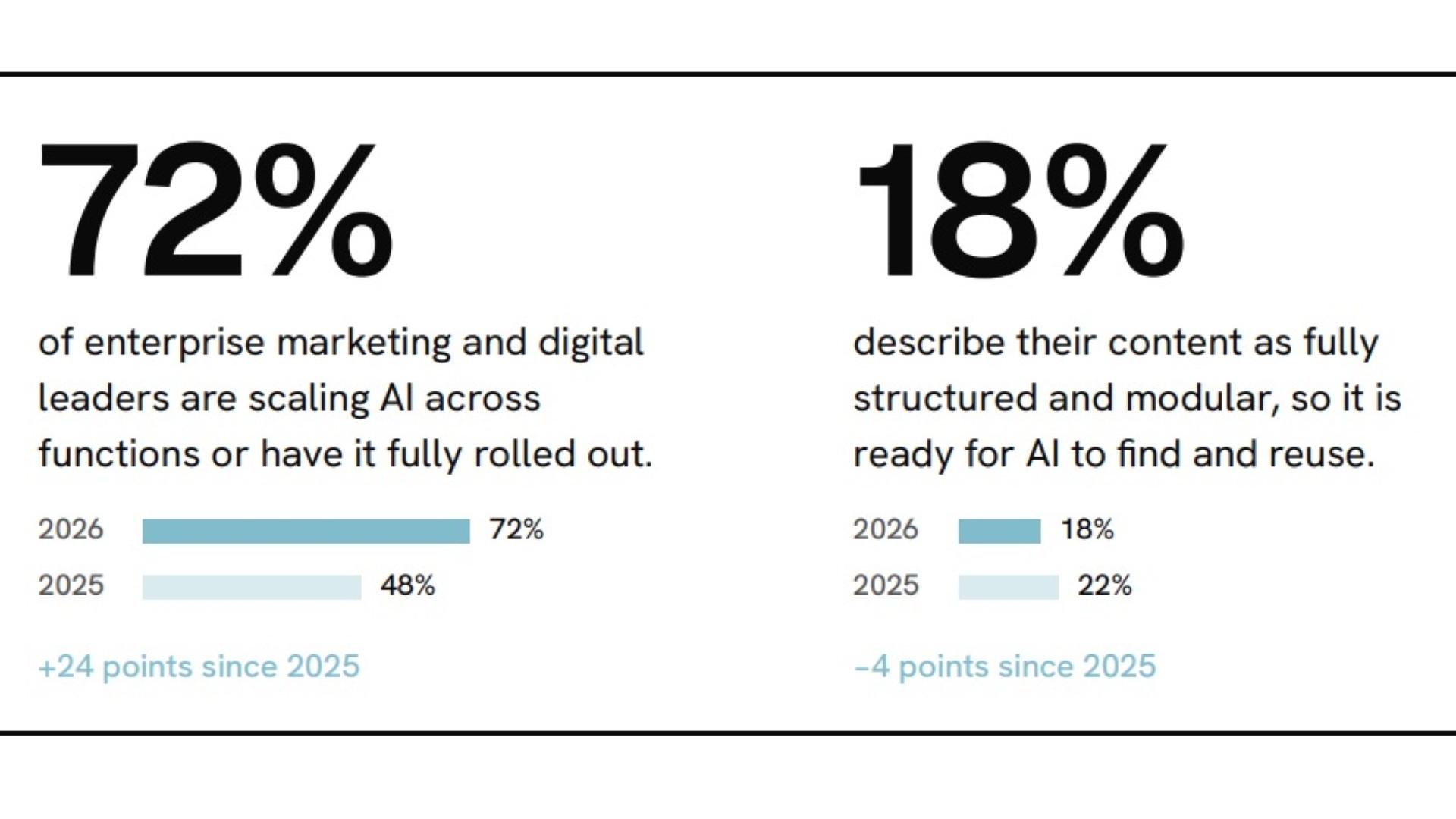
72% of enterprise marketing and digital leaders are scaling AI or have it fully rolled out in 2026, up from 48% in 2025, but only 18% have fully structured content and just 12% can clearly demonstrate AI's business impact.
Key metrics
Key takeaways
- 72% of enterprise marketing and digital leaders are scaling AI or have it fully rolled out, up 24 points from 48% in 2025.
- Only 18% describe their content as fully structured and modular, down 4 points from 22% in 2025, leaving most teams exposed on AI foundations.
- Security (52%), skills (45%) and integration (44%) are the top barriers, while only 18% name budget as a constraint.
- Teams with strong content and platform foundations are far more likely to clearly demonstrate AI's impact (23% vs 3%) and to have AI fully rolled out (39% vs 5%).
- 44% plan to prioritize agentic workflows in the next 12 months, but 80% of those teams do not yet have fully structured content for agents to act on.
A marketing operations lead at a multinational consumer brand asks an AI assistant to draft a campaign brief for a new product launch. Within an hour, the system produces a coherent positioning document that would have taken a team of strategists several days to assemble.
The prototype works.
Trouble starts when the same lead tries to push that brief into the company's content management system, route it through brand review, and publish it across regional sites. Each step requires a human workaround, a custom integration, or a governance exception.
The promise of AI collapses into the friction of the enterprise stack underneath it. That gap between what AI can produce in a day and what an organization can absorb in a quarter is the central finding of the 2026 AI Readiness Report, a survey conducted in October 2026 by WordPress VIP and Human Made.
The headline number is striking: 72% of respondents say they are scaling AI across functions or have it fully rolled out, up 24 points from 48% in 2025. Full rollout alone more than doubled, from 9% to 21%. Yet the foundations that determine whether AI delivers business value have barely moved.
Adoption Has Run Ahead of Infrastructure
The macro picture is one of rapid organizational catch-up. Last year's research described a paradox in which individual employees used AI daily while enterprises moved cautiously. In 2026, that caution has largely evaporated.
Piloting fell by 17 points, and no respondent reported having no plans for AI at all. 89% of organizations now encourage AI use, and 69% have tied AI initiatives to defined business objectives, the strongest score across the report's five-dimension benchmark.
Adoption has outpaced the underlying content and platform readiness required to scale it. Only 18% of respondents describe their content as fully structured and modular, down four points from 22% in 2025. Only 12% can clearly demonstrate AI's business impact with clear metrics. 35% either see signs of value they cannot consistently quantify or have no reliable way to measure AI's results at all.
Teams are now running more AI than their content architecture, governance frameworks, and measurement systems can support.
Where the Friction Lives
When asked what stops them from getting more value from AI, enterprise leaders pointed first to security, privacy or compliance, cited by 52% of respondents, followed by skills or knowledge gaps at 45% and integration with existing systems and workflows at 44%.
Budget, often assumed to be the binding constraint, was named by only 18%. Lack of clear strategy was cited by 25%, and uncertainty about ROI by 24%.
The data points to a barrier that fewer teams name but that the report argues deserves more attention: content and platform infrastructure. Only 15% of respondents identified their CMS or content infrastructure as a barrier, yet content architecture and platform flexibility scored lowest in the five-dimension benchmark.
47% agreed their content is structured enough for AI-driven workflows, but only 4% strongly agreed. 46% said their CMS and content stack can support new AI tools, while a quarter disagreed. Foundation problems typically surface under other names: an integration project that takes too long, a governance review that cannot keep pace, a tool that cannot find the right content.
Governance is one of the most divided dimensions. 60% of respondents said they have clear, consistently applied AI policies, while a quarter said they do not. Among teams without clear policies, 60% named security as a barrier, yet only 28% planned to strengthen governance in the next 12 months.
The report frames governance not as a brake but as the mechanism that lets organizations say yes to AI more often: 87% of teams with clear AI policies are scaling AI or have it fully rolled out, compared with 50% of other teams.
Voices from the Front Line
The qualitative responses collected alongside the survey data capture the operational reality behind the percentages.
One marketing leader, piloting AI in some teams, described being forced to use Microsoft Copilot due to security concerns that blocked access to Gemini, ChatGPT and Claude. Another, scaling AI across functions, warned that training and integration into daily workflows had to happen before headcount was reduced, calling it the one stumbling block upper management refuses to acknowledge.
The value so far is concentrated in speed. 61% of respondents named faster content or campaign production as a top gain, and 56% cited more efficient use of resources.
Gains in business outcomes trailed well behind: better campaign performance at 25%, personalization at 13%, customer engagement at 11%, and reach or discoverability at just 7%.
One leader described cutting monthly reporting from a full working day to 15 minutes by automating data aggregation with agents. Another said rough thinking could now become a coherent framework in hours rather than months. For now, teams are mostly doing what they already did, only faster.
The teams I see move fastest make the decision once and reuse it. To do that, they have to be able to say what AI is allowed to touch. That is much easier when content already sits in structured, approved pieces a machine can find and reuse.James Giroux, Customer Success, WordPress VIP
The Foundations Divide
To test whether infrastructure matters, the report compared two groups: the 31% of respondents who agreed both that their content is AI-ready and that their CMS can support new AI tools, and the 37% who disagreed with at least one of those statements.
The gap was stark. Among teams with strong foundations, 23% could clearly demonstrate AI's impact, compared with 3% of teams with weak foundations. 39% of the strong-foundations group had AI fully rolled out, against 5% of the weak-foundations group. 81% of the strong-foundations group had clear AI policies, compared with 51% of the weak-foundations group.
The comparison shows an association rather than proof of causation, but the practical point holds: the teams that have done the foundational work are the ones scaling AI and showing what it delivers.
The report's authors caution that well-run organizations probably invest in foundations and measurement together, which would inflate the apparent effect. Even so, the directional signal is consistent across every dimension measured.
Agentic Ambition Outpaces the Groundwork
Agentic AI is the next priority for 44% of enterprise teams, second only to expanding AI-assisted marketing and content workflows at 48%.
Yet, the teams planning to prioritize agentic workflows are no better prepared than the rest of the sample. 80% of them do not have fully structured content, about the same as everyone else. 52% do not agree their CMS can support new AI tools. They are also less likely than other respondents to prioritize measurement, at 20% versus 41%.
The 21% of respondents with AI fully rolled out offer a glimpse of what maturity looks like. 43% have fully structured content, against 14% among teams still scaling. 33% can clearly demonstrate impact, against 10%. 62% plan to prioritize agentic workflows next.
Start agentic projects small: pick one repeatable process with a clear start and finish, such as tagging new content or preparing a weekly report, give the agent structured inputs, a defined handoff point, and a human review step. Most of the effort goes into the content model and the process design. The agent itself is often the easy part.2026 AI Readiness Report
The Enterprise Playbook for the Next 12 Months
The report's authors translate the findings into five moves, one for each dimension of the AI Readiness Framework:
- Strategic alignment: they recommend tying every AI goal to the foundation it depends on and putting content, data, and platform capabilities on the same roadmap as the AI objectives themselves.
- Operational capability: they urge leaders to standardize what already works: take the workflows that run well for one team, document them, assign an owner, and train people before rollout.
- Governance: they recommend keeping policy short, practical, and easy to find, and reviewing it every quarter because the tools change that often.
- Content architecture: the advice is to finish the move to structured content. Two-thirds of teams remain partially structured, and that share has not moved in a year. Start with the content types AI touches most, such as product, campaign, or editorial content, and model them properly.
- Platform flexibility: the report recommends choosing open over all-in-one: a CMS and content stack that connects through open APIs lets organizations adopt useful AI tools and drop the rest without starting over. A platform that turns each new tool into a custom project will set the pace of everything else.
Editorial FAQs
How many enterprise teams have scaled AI in 2026?
72% of enterprise marketing and digital leaders say they are scaling AI across functions or have it fully rolled out, up from 48% in 2025. Full rollout alone more than doubled, from 9% to 21%.
What is the biggest barrier to getting more value from AI?
Security, privacy or compliance is the most cited barrier at 52%, followed by skills or knowledge gaps at 45% and integration with existing systems at 44%. Budget is named by only 18%.
How many teams can show what AI is delivering?
Only 12% can measure AI's impact very effectively with clear metrics, while 35% either see signs of value they can't quantify or have no reliable way to measure it.
Are teams ready for agentic AI?
44% plan to prioritize agentic workflows in the next 12 months, but 80% of those teams do not have fully structured content and 52% do not agree their CMS can support new AI tools.