A
Aditi Sawhney
Senior Vice President, Security Solutions, Asia Pacific · Mastercard
Mastercard's Aditi Sawhney outlines bounded autonomy, continuous monitoring and accountability for scaling AI agents without losing control or trust.
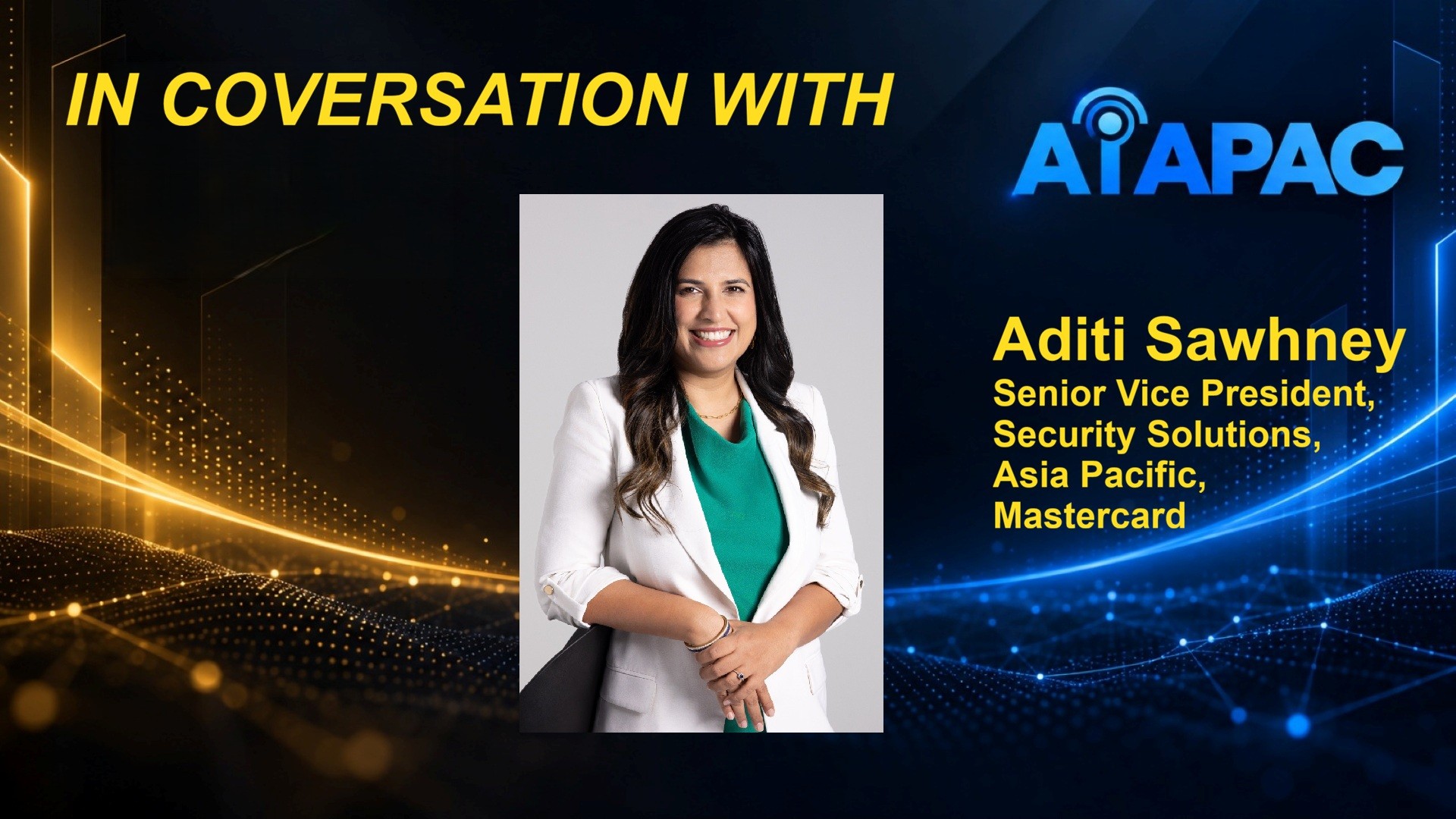
In conversation
Senior Vice President, Security Solutions, Asia Pacific · Mastercard
Mastercard’s Aditi Sawhney explains how businesses can govern AI agents through bounded autonomy, monitoring, security and accountability.
As AI agents move from experimentation into customer interactions, business decisions and transactions, the central question is no longer only what they can do, but what they can be trusted to do consistently and at scale.
Aditi Sawhney, Senior Vice President for Security Solutions in Asia Pacific for Mastercard, believes that bringing together effective governance, intelligence-led defense, ecosystem visibility and strong security fundamentals into agentic AI - from development through to deployment - is how businesses can scale AI without compromising control or trust.
In an interview, Sawhney explains why permission does not always establish intent, how bounded autonomy can reduce unnecessary human approvals, and why AI trust has become a business issue rather than a cybersecurity concern alone.
As AI enters real-world deployment, identity and access controls remain fundamental, but an authorized action may still fail to reflect what a consumer or business intended.
Sawhney says organizations must verify who or what is acting, what authority has been granted, whether the action stays within those boundaries and who is accountable if something goes wrong.
She points to authenticated AI-initiated transactions enabled by Mastercard in Singapore and Malaysia as an example of how authentication, tokenization and fraud detection must evolve as agents participate in transactions.
As AI moves from experimentation into realAditi Sawhney, Senior Vice President, Security Solutions, Asia Pacific, Mastercard
Sawhney argues that businesses should not pursue maximum autonomy. Instead, they should define which activities can be delegated, where human judgment remains essential and who remains accountable for the outcome.
Her recommended starting point is identity: organizations should establish who is responsible for an agent, what function it represents and what authority it has received. A zero-trust approach should begin with narrow permissions and expand only after testing.
Routine, lower-risk activity can proceed within limits such as time, budget or task. Higher-risk, unusual or difficult-to-reverse actions can trigger confirmation, review or decline rather than requiring approval for every action.
The goal should not be maximum autonomy. The sweet spot is clarity about what can be delegated to an AI agent, where human judgment remains essential and who is accountable for the outcome.Aditi Sawhney, Senior Vice President, Security Solutions, Asia Pacific, Mastercard
Before deployment, organizations should test agents across a range of scenarios, assess where they may fail and confirm that they operate reliably. Sawhney also recommends maintaining traceability and auditability before expanding an agent’s authority.
She says legitimate agents may behave differently from humans by acting at unusual hours, across geographies or through rapid, repeated purchases. Context across identity, intent, behavior and fraud can help organizations distinguish legitimate activity from genuine threats.
Transaction-level insights can provide financial institutions with signals about whether a payment was initiated by an AI agent. That information can support proportionate safeguards, including additional verification for higher-risk transactions without adding unnecessary friction to legitimate activity.
The aim is bounded autonomy, by giving agents room to act within clear limits while keeping their actions visible, traceable and accountable.Aditi Sawhney, Senior Vice President, Security Solutions, Asia Pacific, Mastercard
Sawhney says C-suite leaders should view AI trust as a condition for safely scaling operations and innovation. Gaps in data use, explainability, oversight and accountability can create poor decisions, operational risk, weaker customer confidence and difficulty reconstructing unexpected system behavior.
Without common standards and clear governance, organizations may remain stuck in isolated pilots. Governance can instead give teams the confidence and clarity to move viable use cases into production while managing risk.
The interview frames trusted scale as the next phase of AI adoption: innovation must advance alongside governance, clear standards and human accountability.
AI trust is ultimately a business issue because it determines what an organization can safely scale and whether it can innovate ahead of the competitionAditi Sawhney, Senior Vice President, Security Solutions, Asia Pacific, Mastercard
Sawhney says businesses need clear ownership, accountability, permissions and appropriate human oversight, with AI systems remaining visible and auditable throughout their lifecycle.
She says Mastercard established its AI governance function in 2019, covering internally and externally procured AI and supported by Privacy by Design and organization-wide responsibility principles. She also cites external engagement involving ISO SC42, NIST, IMDA, MAS and BuildFin.AI on agent identity, monitoring, human oversight and safeguards for agentic finance.
Businesses also need AI-powered defenses against AI-powered attacks, real-time risk capabilities and connected network intelligence. Across vendors and partners, continuous third-party risk monitoring should provide visibility into how AI is being used.
Core controls remain important, including patching, data security, credential hygiene, phishing-resistant multifactor authentication, secure configuration and logging. Sawhney’s position is that AI increases the speed and scale of threats without reducing the importance of cybersecurity fundamentals.
Businesses need to secure their use of AI, strengthen their wider cybersecurity defenses and continue mastering the fundamentals.Aditi Sawhney, Senior Vice President, Security Solutions, Asia Pacific, Mastercard
An agent may be technically authorized to perform an action without that action reflecting what the consumer or business actually intended.
Bounded autonomy gives agents room to act within clear limits while keeping their actions visible, traceable and accountable.
They should establish governance from the start, define ownership and permissions, test and monitor agents, maintain auditability, secure the wider ecosystem and protect core cybersecurity fundamentals.