Pretxt Emerges from Stealth to Pioneer AI Supervision
Security veterans introduce purpose-built runtime technology to supervise AI agents, guiding them back on course before mistakes become business consequences
November 19, 2026 · 6 min read
Executive summary
Pretxt emerged from stealth with $5 million in seed funding to launch AI Supervision, a runtime layer that evaluates enterprise AI-agent behavior against business processes and steers agents back when execution drifts, without using LLMs as a judge.
Key metrics
Key takeaways
- Pretxt emerged from stealth with $5 million in seed funding from Deciens Capital, Howdy Partners, NSV Wolf Capital and Service Provider Capital.
- The company says its supervision technology operates 60 times faster because it does not use LLMs as a judge.
- In Zapier’s AutomationBench tests, Pretxt reduced agent actions violating company policy from nearly one in five to zero.
- Pretxt analyzes agent behavior and proposes supervision-plan refinements, with enterprise teams approving changes before implementation.
- Applications include customer support, marketing, financial services, healthcare, pharmaceuticals, life sciences and insurance.
Pretxt emerged from stealth this week with $5 million in seed funding and a pointed thesis: the enterprise AI stack is missing an operational layer that watches agents while they work, not after the fact.
The company is calling that layer AI Supervision, a discipline it argues is distinct from security, governance and observability, and one that becomes unavoidable as agents graduate from drafting emails to processing transactions, talking with customers and operating regulated business processes.
Pretxt's founders, Chief Executive Brian Soby and Chief Technology Officer Aaron Costello, both veterans of enterprise security and infrastructure, posit the launch around a simple operational reality: agents can act, but they do not reliably follow the rules.
A customer-service agent promising an unapproved refund, or a financial-services agent bypassing verification, can create immediate financial, operational and reputational exposure, and these failures do not require a malicious attacker. Meanwhile, 83% of US consumers say brands should be held accountable when an AI-powered interaction goes wrong.
A New Operational Discipline for Enterprise AI
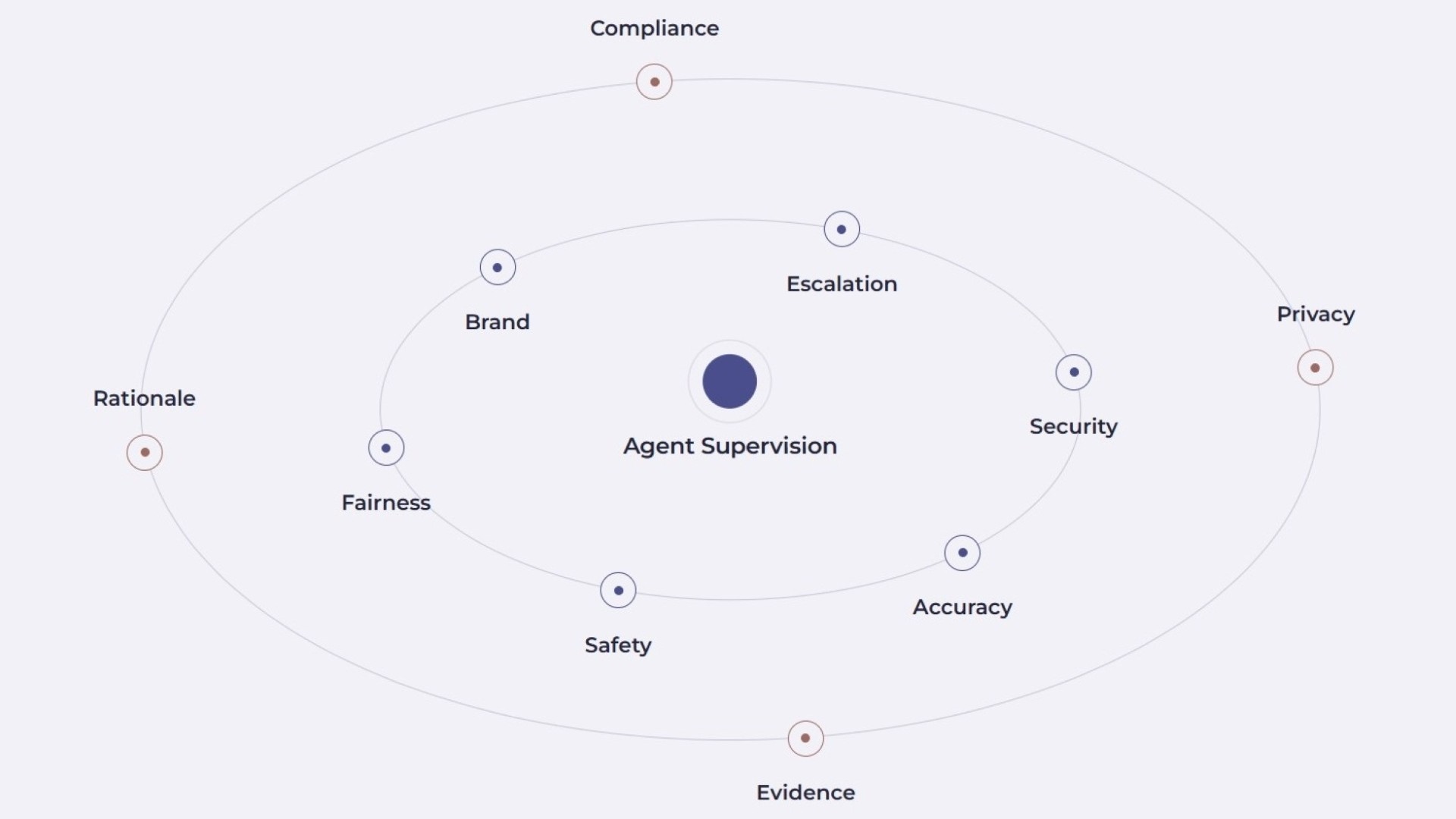
Pretxt is positioning AI Supervision as a distinct enterprise category: continuous oversight of what AI agents do during execution, measured against the organization's own processes, intent and procedures.
The premise is borrowed from how organizations manage human workforces. Companies do not entrust people with consequential work using a rulebook alone; they supervise the work. Pretxt argues the same discipline must apply to agents, particularly as enterprises move them into customer-facing and regulated workflows.
The technical bet is that supervision should not depend on another large language model (LLM) acting as a judge. By design, Pretxt does not use LLMs as a judge, eliminating unnecessary latency, cost and inconsistent judgment calls.
The company claims its runtime layer delivers supervision 60 times faster than LLM-based approaches, with millisecond-scale checks on routine interactions and intervention before proposed actions cross organizational boundaries. Internal tests measured on Zapier's AutomationBench, which represents real-world support workflows, found reduced agent actions that violated company policy from nearly one in five down to zero.
You don't need a prompt injection attack for an AI agent to do something it shouldn't. Security remains essential, but the next question is whether enterprises can trust agents to carry out real work according to their standards. You can't supervise a workforce of AI agents with hope, a rulebook and reviews after the fact. AI needs supervision while it acts.Brian Soby, co-founder and CEO, Pretxt
Direct Dialogue: Trust, Tools and the Limits of Guardrails
Pretxt is not a replacement for security, governance or observability. Those controls answer different questions: whether an agent is secure, whether it complies with policy, and what happened after the fact.
Pretxt addresses the operational gap of understanding what an agent is supposed to accomplish and guiding it when execution drifts, without stalling the work. Some guardrails block prohibited actions and leave the in-flight process waiting for human intervention; monitoring tools report what happened. Supervision, by contrast, intervenes while the outcome can still change.
Costello, who leads the technology roadmap, framed the design choice around reducing the burden on the teams responsible for agent behavior. Pretxt's interface lets teams describe expected behavior and boundaries in plain language, then supervises and steers the agent to stay within them.
Every agent has its own tools and its own way of working. Nobody should have to master all of that before they can trust an agent with real work... The agent already knows its job. Teams tell us, in plain language, how it should behave and where the boundaries are, and we supervise and steer the agent to stay within them. No untangling permissions, no digging into the agent's internals. That's a big win for trust, and for outcomes.Aaron Costello, co-founder and CTO, Pretxt
Operational Reality: Where Supervision Earns Its Keep
Pretxt is targeting consequential enterprise workflows, particularly in regulated industries where an agent's misstep carries financial, operational, reputational or compliance consequences - such as customer support, marketing, financial services, healthcare, pharmaceutical and life sciences, and insurance.
In each, the supervision layer is meant to enforce a specific operational discipline: customer-support agents stay within the line between estimates and confirmed commitments; marketing campaigns stay inside approved claims and offers; financial-services agents honor authorized repayment terms and required verification steps; healthcare scheduling and benefits agents respect clinical boundaries and escalate questions that need professional judgment; insurance agents route coverage exceptions, fraud indicators and high-value settlements to designated human approvers.
The platform is also designed to improve through experience. Pretxt analyzes real-world agent behavior to identify gaps in guidance and operating boundaries, then proposes refinements to the supervision plan. Enterprise teams test proposed plans against their own examples and approve changes before they take effect, a deliberate guardrail against agents rewriting their own rules.
Michael Sampson, Principal Analyst at Osterman Research, said organizations are accountable for the decisions and actions of their AI agents, and that getting it wrong has real consequences, framing Pretxt's supervision engine as a way to make agents dependable at scale.
Chris Steffen, Vice President of Research at Enterprise Management Associates, argued that most enterprise tools can only report what went wrong after the fact, when it is too late, and that Pretxt intervenes while the outcome can still change.
Enterprises have invested heavily in tools that ask whether an agent is secure, compliant or observable. Far fewer can answer a more basic but critical question: Is the agent correctly doing the job it was given? That's important because organizations that deploy AI own their outcomes, no matter who's asking: regulators, insurers or customers.Chris Steffen, VP of Research, Enterprise Management Associates
The Parting Horizon: From Pilot Projects to Consequential Work
For enterprise decision-makers, the company is mapping its value proposition to specific roles.
CIOs, CTOs and Chief AI Officers are positioned to scale agents into customer-facing and business-critical operations with greater confidence.
Business and customer experience leaders can be assured that agents uphold company standards and honor commitments. Risk, compliance and privacy leaders are offered a way to translate policies into real-time supervision of agent behavior.
CISOs and security leaders can see Pretxt addressing a critical gap in AI risk management by preventing unintended agent behavior even when no attacker is involved.
AI and platform engineering leaders are offered consistent, low-latency supervision without adding another LLM to evaluate every agent decision.
The founders are betting that as agents move from pilot projects into workflows where mistakes have real consequences, AI supervision will no longer be optional.
Editorial FAQs
What is Pretxt launching?
Pretxt is launching AI Supervision, a runtime layer that evaluates AI-agent behavior against an organization’s processes, intent and procedures and guides agents when execution drifts.
How much funding did Pretxt raise?
Pretxt raised $5 million in seed funding from Deciens Capital, Howdy Partners, NSV Wolf Capital and Service Provider Capital.
How does Pretxt supervise AI agents?
Enterprise teams define expectations and boundaries in plain language. Pretxt evaluates agent behavior during execution, identifies deviations and steers agents back on course, while proposed supervision changes require human approval.
What results did Pretxt report?
Pretxt says its technology provides supervision 60 times faster and reduced policy-violating agent actions from nearly one in five to zero in tests measured on Zapier’s AutomationBench.