The Real Challenge Beyond Agentic AI Washing
Agentic AI adoption will succeed only if leaders fix fragmented systems, workflows and governance rather than simply deploying more agents.
November 16, 2026 · 5 min read
Executive summary
The central barrier is not model capability but enterprise readiness: fragmented systems, incomplete data, disconnected workflows and insufficient governance for autonomous AI agents.
Key metrics
Key takeaways
- OutSystems' 2026 report found 96% of organisations already use AI agents, while 97% are considering broader deployment.
- The report found 94% of organisations worry that AI is increasing technology-management difficulty, security risks and existing IT problems.
- Only 12% of organisations have a central system overseeing how AI agents are used across the business.
- Bank of Singapore reduced average source-of-wealth report preparation from 10 days to one hour using an agentic AI-powered tool.
- Deloitte found only 21% of organisations globally have mature governance models for autonomous AI agents.
The conversation around enterprise AI is shifting from what AI can generate to what it can actually do. AI agents, which can carry out tasks and act across business systems, are quickly becoming the next big area of investment.
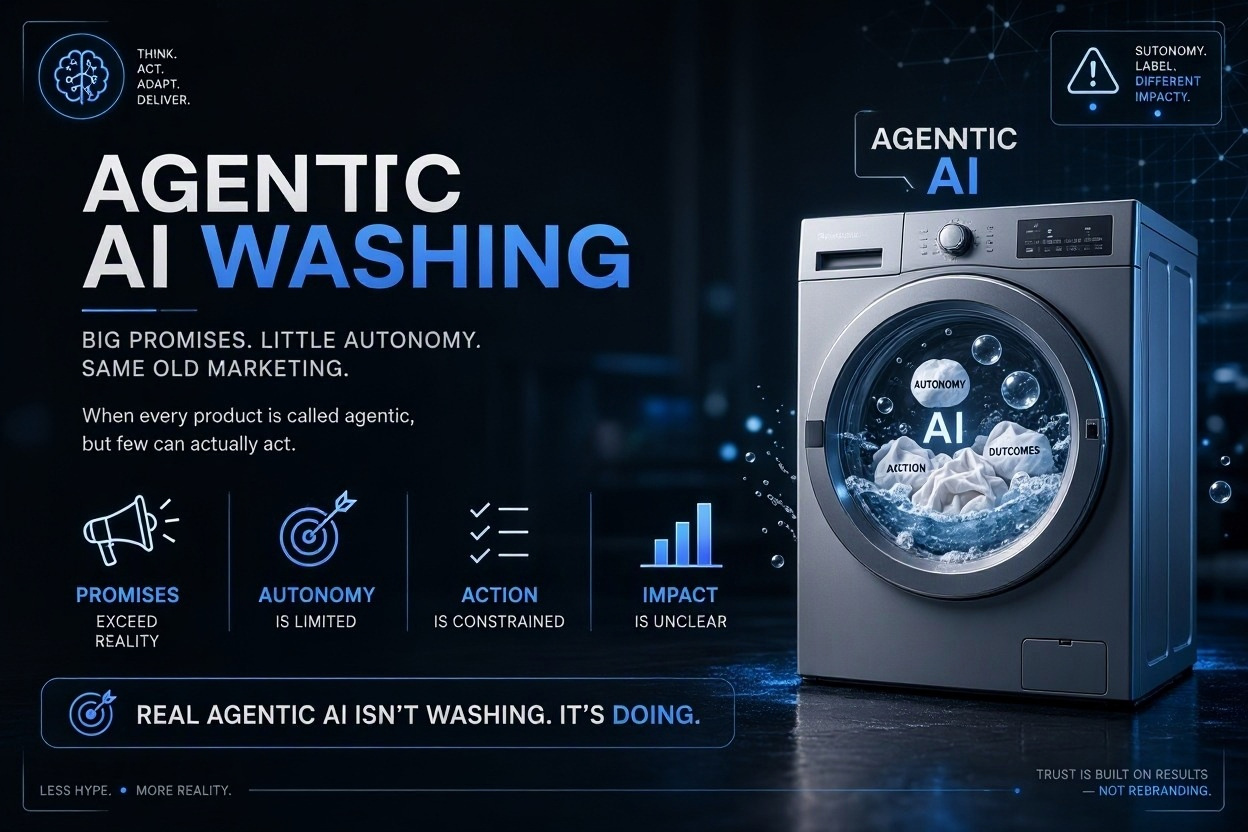
That momentum has also brought a familiar problem. Just as "greenwashing" became shorthand for overstated environmental claims, terms such as "agent washing" and "agentic AI washing" are surfacing to describe existing automation or AI capabilities being rebadged as agents.
The concern is valid. But for companies investing heavily in AI, there is a bigger risk. It is the belief that agents can somehow work around years of legacy technology, disconnected systems and fragmented data.
According to OutSystems' 2026 State of AI Development report, 96% of organisations are already using AI agents in some form, while 97% are looking at how to use them more widely across the business. Yet 94% are concerned that the rapid spread of AI is making their technology environments harder to manage, while adding to security risks and existing IT problems. Only 12% have a central system in place to oversee how AI agents are used across the organisation.
The figures show that rapid adoption can create problems of its own. More agents do not necessarily make a business more intelligent. Without fixing the environment around them, companies may simply add a new layer of complexity to an old problem.
New agents cannot overcome old foundations
AI agents are expected to do much more than answer questions. They can verify documents, retrieve information, make recommendations and carry out tasks across different business systems.
That means the systems and data behind them still matter.
Large organisations typically rely on applications accumulated over many years. Different teams may use different systems, store information separately and follow processes that were never designed to work together.
An AI agent is still limited by what it can access. If the information is incomplete, outdated or scattered across disconnected systems, the agent inherits those weaknesses. And when AI starts taking action rather than simply producing an answer, the consequences become more significant.
This is where the gap between AI ambition and enterprise readiness becomes apparent. AI capabilities have moved quickly. Many of the systems and processes they depend on have not.
Deloitte's Tech Trends 2026 research points to legacy integration as one of the obstacles companies face when putting agentic AI to work. Increasingly, the limiting factor is not the model itself, but the environment it has to operate in.
That does not mean businesses need to replace every legacy system. Few companies have the time, budget or appetite for that.
Start with the workflow, not the technology
Instead of asking "where can we deploy an agent?", businesses should first ask: "where is work breaking down today?"
That might be a manual review that takes days, an employee moving between several systems to complete one task, or a process slowed down because information sits in different places.
These are often better starting points for AI than deploying an agent simply because the technology is available.
Once the problem is clear, companies can work backwards. What information does the agent need? Which systems does it need to connect to? Where does human judgment still matter? What needs to change for the process to work better?
This makes modernisation more focused. Rather than trying to overhaul every system at once, companies can improve the systems and processes around the areas where AI can deliver a clear business return.
Businesses should retain the flexibility to use different models and tools as their needs change, while ensuring they can still work with the applications, data and processes already running the business.
AllianceCorp Manufacturing (ACM) offers one example. Its engineers are using an AI agent to extract specific information, such as title blocks and geometric tolerances, from two-dimensional Computer-Aided Design drawings. It is a practical use case focused on a clearly defined engineering task.
A similar example is Bank of Singapore, which has embedded SOWA, an agentic AI-powered source-of-wealth tool, directly into its KYC workflows. The bank says it reduced the average preparation time for source-of-wealth reports from 10 days to one hour.
Success depends on integration and governance
As AI moves from answering questions to taking actions, the need for oversight becomes much greater. Organisations need to know what their agents can access, what they are allowed to do and where a person still needs to make the final call.
Yet Deloitte found that only 21% of organisations globally have mature governance models for autonomous AI agents.
Without those controls, companies risk ending up with the AI equivalent of the fragmented technology estates they are already trying to fix: different agents built by different teams, working across different systems with limited visibility over how they interact.
That would be an expensive way to repeat an old mistake.
As spending on agentic AI grows, companies should therefore be careful about how they define progress. The number of agents deployed is not a particularly useful measure of success. Faster processes, lower costs, better decisions and stronger customer experiences are.
The debate over "agentic AI washing" will continue as vendors race to attach the term to their products. But for business leaders, whether a product meets the purest definition of an AI agent may ultimately be the easier question.
The harder one is whether the business is ready.
Editorial FAQs
What is agentic AI washing?
Agentic AI washing describes existing automation or AI capabilities being presented as AI agents, similar to how greenwashing refers to overstated environmental claims.
Why can legacy systems limit AI agents?
Agents depend on the systems and data they can access. Incomplete, outdated or disconnected information can limit their performance, particularly when agents take actions across business systems.
How should companies identify agentic AI use cases?
Companies should begin with workflows that are breaking down, such as manual reviews, tasks requiring employees to move between systems, or processes slowed by fragmented information.
What governance is needed for autonomous AI agents?
Organisations need visibility into what agents can access, what they are allowed to do and where human approval remains necessary.