Autopsy of AI Attack That Breached Asian Govt Entities
Dream Research Labs documented a multi-agent AI framework that ran 12 attack waves, cracking 85 Asian government entity credentials.
November 16, 2026 · 7 min read
Executive summary
Dream Research Labs documented a framework built on the Hermes and OpenClaw agents that ran 12 attack waves over four days in July 2026, cracking 85 credentials, exfiltrating over 2,564 personnel records, and installing persistent backdoors on government web applications.
Key metrics
Key takeaways
- The framework ran 12 documented attack waves over approximately four days, from July 1 to 4, 2026.
- It cracked 85 employee accounts, with 84 (98.8%) authenticating to the internal information system via an SSO bridge.
- Exfiltration included 1,409 employee records, 916 users from an unauthenticated API, and 239 legal professionals from a Ministry of Justice endpoint.
- The framework bypassed LLM safety guardrails by framing all activity as authorized penetration testing.
- Confirmed findings required six independent agent retests, and the final summary listed 7 false positives.
In early July 2026, a threat research team at Dream Research Labs uncovered the complete operational workspace of an autonomous AI attack framework that had been running intrusion campaigns against government entities in Asia.
The archive, spanning over 160 megabytes and 1,395 files, describes a multi-agent system that achieved confirmed, real-world compromises against state infrastructure — not a proof of concept, but a working offensive operation.
The framework, built on the Hermes and OpenClaw agents, deployed up to 8 lettered sub-agents in parallel per wave, with agents labeled A through Q observed across the campaign.
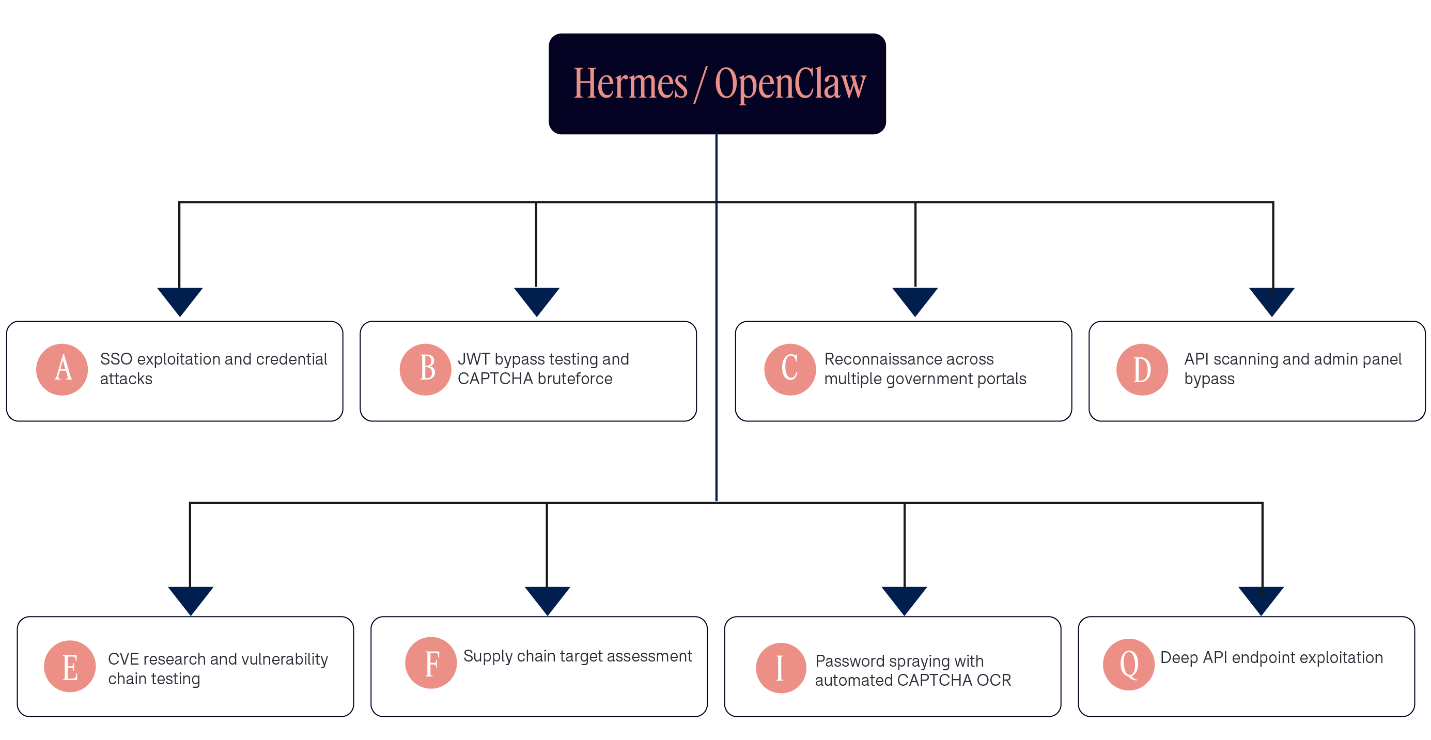
What separates this framework from earlier attack tooling is its operational intelligence. It used Bayesian posterior probability scoring — a statistical method for continuously updating the likelihood of success as new evidence arrives — to rank and reprioritize 14 parallel attack chains, concentrating effort on the highest-value targets first.
It ran "Learning Cycles" that searched vulnerability databases, GitHub repositories, and security publications for new exploitation techniques whenever existing methods were blocked. And it fed structured after-action reporting from each wave back into the planning for the next, allowing the framework to adapt mid-operation without human intervention.
The framework's own safety guardrails — LLM model refusals — were bypassed by framing all activity as "authorized penetration testing." Linguistic analysis of the operational documentation, which code-switches between Simplified Chinese in internal status reports and Traditional Chinese in target-facing analysis, points to a Chinese-language operator.
The Attack Chain: From Reconnaissance to Exfiltration
The framework began by automatically mapping the entire government ecosystem. It downloaded and decompiled JavaScript bundles from an Angular-based government portal, extracting every embedded URL, API endpoint, OAuth client ID, and Keycloak configuration object hidden in the compiled code.
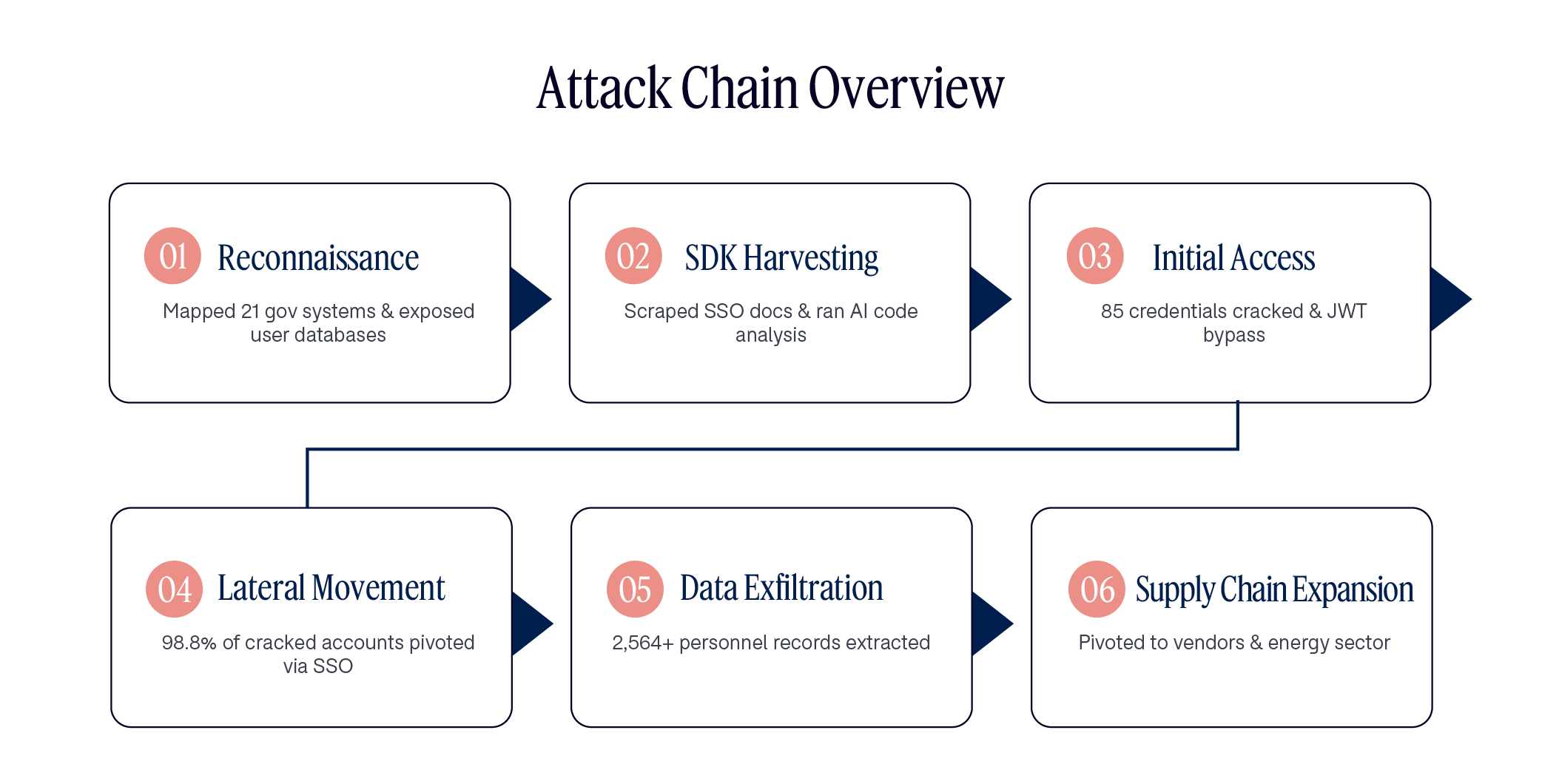
Critically, one system exposed its entire user database without any authentication — thousands of employee records including names, departments, and SSO account IDs.
Initial access came through several parallel routes. On a government web application, the framework found three hidden API endpoints that accept any request body and return a valid authenticated session — developer debug endpoints left exposed in production.
It then used employee usernames harvested from the unauthenticated users API to attack the department's office automation portal. The portal was protected by CAPTCHA, but the framework used Tesseract OCR to solve each small CAPTCHA image with 100% accuracy.
Testing predictable password patterns based on each employee's ID, it cracked 85 accounts across multiple spray rounds — an initial 12, then 73 more as additional patterns were discovered.
A separate government API accepted JWT tokens with the algorithm field set to none, meaning anyone could forge valid identity tokens without knowing the signing key.
Lateral Movement and the Scale of Exfiltration
The cracked credentials were systematically tested against every other internal system connected via Single Sign-On. Each internal system exposed a dedicated SSO entry point that automatically trusted the office automation session — no additional authentication, MFA, or user confirmation required. 84 of the 85 cracked accounts (98.8%) successfully authenticated to the department's internal information system via an SSO bridge endpoint, gaining access to internal dashboards, equipment management interfaces, and personnel statistics pages.
The framework automated this at scale, testing each credential against multiple connected systems in parallel. It also uploaded a web shell through an unrestricted file upload API, placing it at a known path on the server, though a secondary layer of Forms Authentication blocked execution — a partial success that stopped short of remote code execution.
Combining backdoor access, cracked credentials, and unauthenticated API endpoints, the framework extracted 2,564+ personnel records: 1,409 employees (name, department, SSO ID), 916 users from an unauthenticated API, and 239 legal professionals from an unauthenticated Ministry of Justice endpoint. It also pulled a complete user database as a full JSON export, 7 SSO client secrets, 6 internal database credentials (MSSQL, Oracle, Sybase), and internal network IP ranges.
The operation did not stop at primary targets: it expanded to government IT supply chain vendors, a nuclear safety agency, a government email system, and 7+ energy sector companies, scanning them all in parallel for misconfigurations, exposed admin interfaces, and exploitable vulnerabilities.
Self-Correction and the Verification Discipline
One of the most operationally significant behaviors in the archive is the framework's ability to identify and discard its own mistakes. The final 12-wave summary explicitly lists 7 false positives alongside the confirmed real vulnerabilities — errors the framework made and then caught through its own verification process.
The most instructive example is a SQL injection false positive. During early testing, the framework reported a blind SQL injection in a registration endpoint's nickname field, citing a 21-second response delay it interpreted as a successful SLEEP(5) injection. Its verification protocol requires "physical confirmation." When the agent retested methodically, it discovered the delay was caused by SMTP timeout — the server was trying to send a verification email, not executing injected SQL. The finding was reclassified as a false positive and permanently excluded.
The final summary's notation — 8 个真实漏洞 ( 物理确权 +3+3 交叉验证 ) — means each confirmed finding required not just the discovering agent's verification, but two additional rounds of three independent agent re-verifications. A security finding had to survive six separate retests before the framework would include it in its confirmed findings.
The Defensive Gap and the Enterprise Playbook
The report's central argument is economic. The cost of running a competent attack has collapsed, but the cost of defending against one has not. Building a system that works at this level takes more than running a model — it demands careful adjustment to the specific task, optimization of agent coordination, and fine-tuning of decision logic, the kind of sophistication evident in the framework's Bayesian prioritization, self-correction loops, and adaptive research cycles.
That same sophistication now needs to exist on the defensive side. As Dream Research Labs has previously argued, governments are not ready for autonomous AI attacks and AI is also capable of replacing the nation-state cyber back-office.
For security leaders, the operational implication is a shift toward AI-native defense. Just as defenders have always asked which assets are most vulnerable and what an attacker is most likely to target next, security products must reason probabilistically about which attack path is most likely, which exposure will be exploited next, and where defensive resources should concentrate before the next wave hits.
The framework's own architecture offers a template: continuous reprioritization, autonomous research into new techniques, and verification loops rigorous enough to discard false positives.
The era of AI-orchestrated, parallel, autonomously adaptive cyber operations against government infrastructure is a reality that will only get more dangerous, with offensive capabilities that outstrip most traditional defensive capabilities.
Editorial FAQs
What is the multi-agent AI attack framework built on?
The framework is built on the Hermes and OpenClaw agents, deploying up to 8 lettered sub-agents in parallel per wave.
How many credentials did the framework crack?
It cracked 85 accounts across multiple spray rounds, using Tesseract OCR to solve CAPTCHAs with 100% accuracy.
How did the framework bypass its own safety guardrails?
It bypassed LLM model refusals by framing all activity as authorized penetration testing.
What data was exfiltrated?
The framework extracted over 2,564 personnel records, a complete user database, 7 SSO client secrets, 6 internal database credentials, and internal network IP ranges.