Singapore AI Job Ads More Than Triple, Jobstreet Data Shows
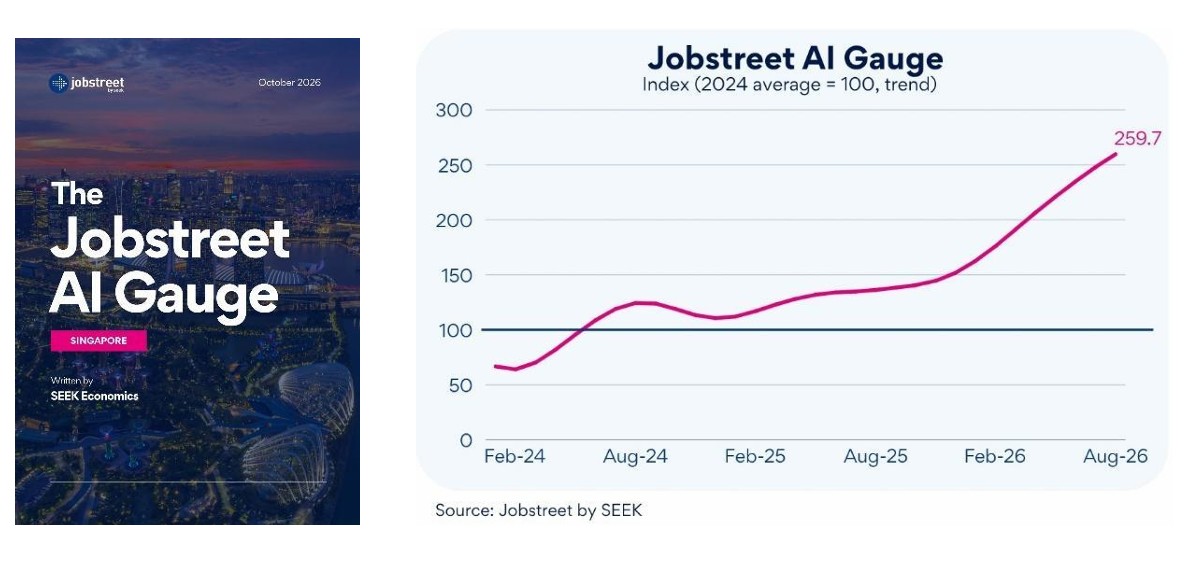
Jobstreet by SEEK data shows Singapore’s AI-related job ads more than tripled from January 2024 to August 2026, with demand spreading across industries and specialised roles.
Key takeaways
- Singapore has the third-highest share of AI job ads across SEEK’s eight Asia Pacific markets, behind Hong Kong at 6.6% and Thailand at 5.2%.
- The share of ICT job ads mentioning AI-related terms rose from 7.2% to 21.3% between the six months to August 2024 and August 2026.
- Advertising, Arts & Media saw its AI-related share of job ads increase from 2.3% to 10.2%.
- In 2026, AI engineer and automation engineer joined software engineer among the most common AI-related role titles.
- New roles include full-stack AI engineer, AI solutions engineer, data privacy and AI trust officer, AI model trainer and AI video creator.
For employers hiring in Singapore, the AI labour market is no longer limited to data scientists and software developers. Job advertisements now point to a wider operating shift, with organisations seeking people who can build models, integrate AI into business processes, prepare workforces and support responsible deployment.
The share of Jobstreet by SEEK job ads mentioning AI-related skills increased from 1.3% in January 2024 to 5.1% in August 2026, according to the company’s AI Gauge. Although AI-related advertisements remain a relatively small share of overall hiring activity, the sustained increase indicates that demand is spreading across industries and into specialised roles, from AI engineering and automation to data privacy, trust and data-centre operations.
Singapore’s AI hiring curve accelerates
Singapore recorded the third-highest share of AI job ads across SEEK’s eight Asia Pacific markets, behind Hong Kong at 6.6% and Thailand at 5.2%. SEEK’s Asia Pacific operations cover Australia, Hong Kong, Indonesia, Malaysia, New Zealand, the Philippines, Singapore and Thailand through its SEEK, Jobstreet and Jobsdb brands.
The fastest growth was recorded in several distinct skill categories. Job ads mentioning machine learning were 93% higher in the three months to August 2026 than in the same period a year earlier, the fastest annual growth among SEEK markets. Mentions of generative AI-related terms, including text generation, foundation models and GPT, increased 92.5% over the same period.
Agentic AI-related terms grew even faster. Mentions increased 460% year on year between August 2025 and August 2026. The data also shows a parallel rise in demand for safeguards and oversight: job ads mentioning AI ethics and governance rose 132% year on year.
The Jobstreet AI Gauge shows how quickly demand for AI skills is changing across Singapore and the region. By analysing job ads over time, we can see which skills employers are seeking and where new opportunities are emerging. This gives us a clearer view of how AI is shaping the labour market across industries and roles.
From technology teams to business operations
Information & Communication Technology had the highest share of AI-related job advertisements. The proportion of ICT ads mentioning AI-related terms rose from an average of 7.2% in the six months to August 2024 to 21.3% in the six months to August 2026.
The roles described in the data reflect the infrastructure and operational requirements of wider AI adoption. Organisations are seeking professionals who can develop and deploy custom large and small language models, build databases and supporting infrastructure, and enable the use of external AI models across the organisation. The focus is therefore extending beyond model development to the systems and processes required to put those models into use.
Science & Technology also recorded a considerable share of AI-related advertisements, including roles such as data scientists and research officers. In Advertising, Arts & Media, the share of job ads associated with AI increased from 2.3% to 10.2%. That movement suggests that AI-related hiring is reaching adjacent professional and creative fields rather than remaining concentrated in core technology functions.
The spread across industries also changes the nature of the workforce requirement. Employers need technical specialists, but they also need people who can connect AI systems with operational workflows, support adoption among employees and address the governance questions created by broader use.
A maturing role structure
The Jobstreet AI Gauge points to a change in the titles most commonly associated with AI-related skills. In 2024, data scientist, software engineer and software developer were the most common role titles. By 2026, AI engineer and automation engineer had joined software engineer among the most common titles.
Newer titles identified in Jobstreet advertisements include full-stack AI engineer, AI solutions engineer, AI and digital transformation executive, data privacy and AI trust officer, AI model trainer and AI video creator. Demand is also emerging around the infrastructure supporting AI, including data centre technician and data centre sales director roles.
Taken together, the roles span the AI value chain. They include the physical infrastructure needed to support computing, the engineering work involved in creating and integrating models, the operational expertise required to apply systems to business activity, and the governance functions needed to oversee their use.
The pattern also indicates that AI-related work is becoming more specialised. Rather than a single category of “AI talent”, job advertisements are identifying distinct requirements for engineering, automation, transformation, training, privacy, trust, creative production and data-centre operations.
The productivity case and the governance requirement
SEEK’s analysis links the growth in agentic AI demand to the prospect of systems completing entire tasks that traditionally required human input. That prospect is increasing interest in professionals who can adopt and maximise the technology, while the expansion of AI use is also creating demand for people responsible for ethical and responsible deployment.
The rapid rise in demand for agentic AI-related skills is unsurprising. Agentic AI offers substantial productivity gains by enabling AI agents to complete entire tasks that would traditionally require human input. As a result, businesses are seeking people with the skills needed to adopt and maximise the benefits of agentic AI.
At the same time, the risks associated with AI are becoming more evident as its use expands, increasing demand for professionals who can support the ethical and responsible deployment of these technologies.
That combination is visible in the figures: agentic AI-related terms rose 460% year on year, while AI ethics and governance mentions rose 132%. The data does not establish how individual employers are deploying these systems, but it shows that demand is rising simultaneously for capabilities associated with automation and with oversight.
Esther Lee, Managing Director of Jobstreet Singapore, said machine-learning demand in Singapore had grown 93% over the past year, the fastest annual growth among the APAC markets where SEEK operates. She linked the increase to AI becoming part of business operations and said employers would need people who could apply the technology in practical ways.
What the hiring data signals
The movement in job advertisements provides a labour-market view of AI adoption rather than a measure of completed implementation. Even so, the progression from 1.3% of all Jobstreet ads in January 2024 to 5.1% in August 2026, alongside the growth of specialised roles, shows that employers are describing AI needs in increasingly concrete terms.
For technology organisations, that means demand is extending from machine learning and software development into model infrastructure, automation and data-centre work. For other sectors, the increase in AI-related advertisements suggests a need for professionals who can translate technical capabilities into operational and creative applications. The rise in governance-related roles indicates that oversight is becoming part of the workforce structure accompanying adoption.
The next phase of Singapore’s AI labour market will therefore be shaped not only by the number of roles created, but by the mix of expertise employers require. Jobstreet’s data identifies a market moving from broad technology capability toward a more distributed model involving engineering, business transformation, infrastructure, content creation, privacy and trust.