APAC CEOs Prioritise AI as Organisational Readiness Rises
Egon Zehnder’s 2026 CEO survey finds AI is APAC’s top challenge, while regional confidence in organisational readiness reaches a three-year high.
Key takeaways
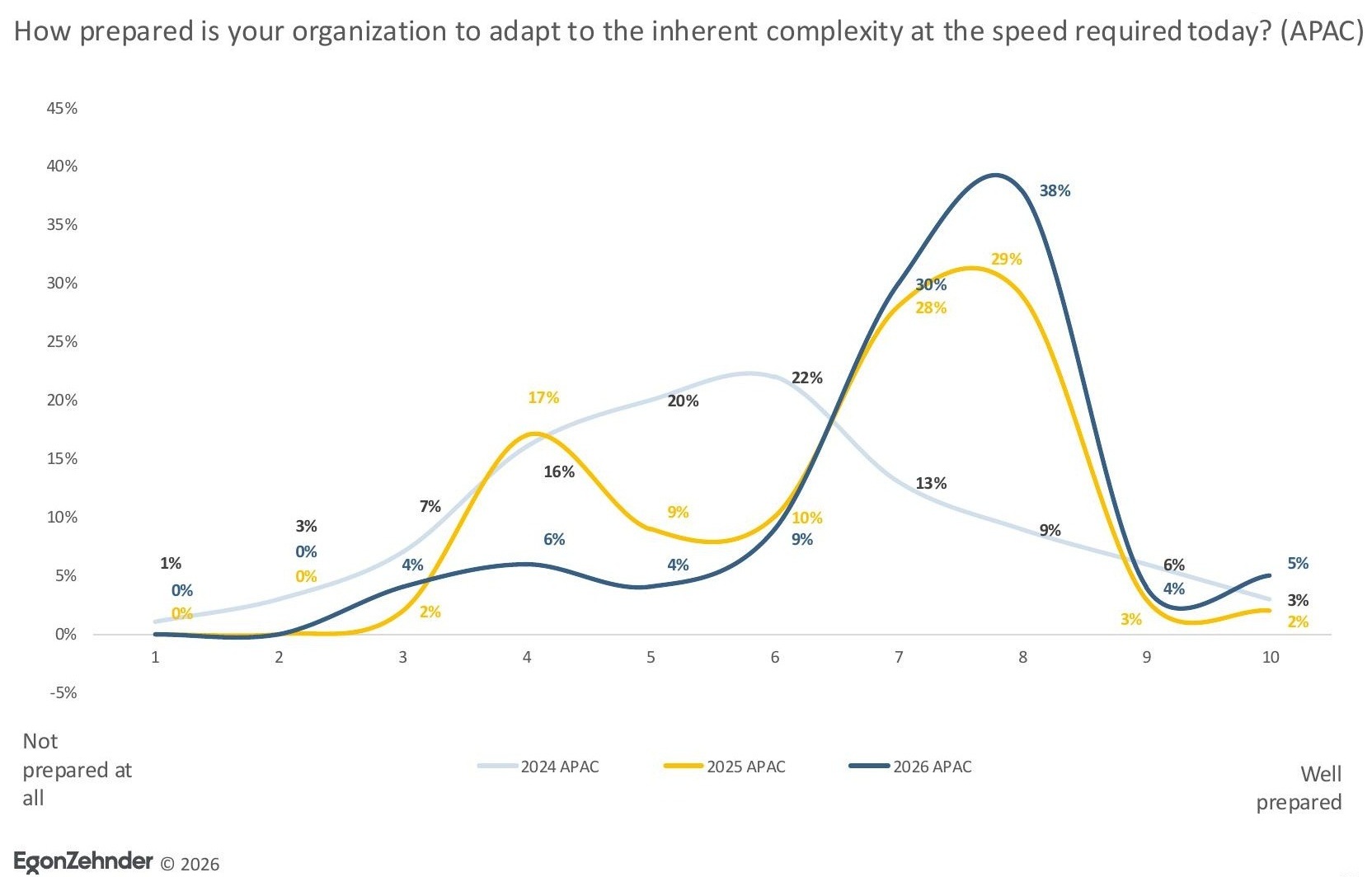
- APAC CEO readiness score rose from 31% in 2024 to 78% in 2026.
- 94% of APAC CEOs rate AI as critical or existentially critical.
- 73% of APAC CEOs expect increased geopolitical disruption in 12 months.
- 72% of APAC CEOs name informal CEO networks as key alliances vs 47% globally.
- 96% of APAC CEOs say success depends on both inner and outer capabilities.
For chief executives across Asia-Pacific, artificial intelligence is no longer a technology issue waiting for a place on the corporate agenda. It has become the region’s most widely recognised organisational challenge, even as leaders prepare for a year they expect to bring greater geopolitical disruption.
Egon Zehnder’s latest global CEO survey, The CEO Response, shows APAC leaders balancing those pressures with a stronger sense of preparedness than their counterparts elsewhere.
The study surveyed 843 CEOs worldwide, including 70 from Asia-Pacific, and was presented at the Berlin Global Dialogue. The regional findings point to a leadership environment in which AI investment is being treated as part of a wider innovation programme, while alliances, executive networks and leadership capabilities are being used to manage uncertainty.
AI Moves Ahead of Other Strategic Risks
AI is rated critical or existentially critical by 94% of APAC CEOs, compared with 91% globally. Only 6% in the region view it as less critical, the lowest proportion recorded for any challenge in the survey.
Geopolitical instability follows at 89% in both APAC and globally. Economic uncertainty is rated critical or existentially critical by 85% of APAC respondents, compared with 89% globally.
The region’s outlook is particularly notable because its leaders expect more disruption, not less. Some 73% of APAC CEOs expect geopolitical disruption to increase over the next 12 months, compared with 62% globally. That expectation sits alongside a sharp increase in reported organisational readiness. The proportion rating their organisation’s ability to adapt at 7 or above on a 10-point scale rose from 31% in 2024 to 62% in 2025 and 78% in 2026. A score of 10 represents being well prepared.
Globally, the same readiness measure moved in the opposite direction, falling from 64% in 2025 to 58% in 2026. Within APAC, 47% of CEOs now rate readiness at 8 or above, compared with 26% globally. The data therefore describes a region where confidence has strengthened despite a more severe expectation of geopolitical turbulence.
Expecting more disruption and feeling ready for it are not contradictory here," said Ang Wan May, Singapore Managing Partner of Egon Zehnder. "Leaders in this region have spent the past three years working through supply chain shocks, conflict and a shifting trade map, and have continued to grow through it... Preparedness in APAC has risen in each of the last three years.
AI Is Being Framed as an Innovation Programme
The survey suggests that APAC executives do not view AI investment as a standalone corporate initiative. When asked about major changes they are implementing, innovation is cited by 54% of regional respondents, compared with 48% globally. AI investment follows at 43% in APAC, against 50% globally. Worldwide, the order is reversed, with AI investment ranked ahead of innovation.
New strategic alliances and partnerships rank third among the major changes cited by APAC CEOs, at 37%, compared with 30% globally. The ordering reflects emphasis rather than an exclusive choice, according to the report: AI is treated as part of the broader innovation agenda rather than as a separate programme funded in isolation.
The survey also identifies a pronounced regional preference for business relationships. Informal CEO networks are named among the most important alliances by 72% of APAC respondents, compared with 47% globally. Public-private partnerships are valued by 41% in APAC, against 32% globally, while 56% say business alliances have become more important over the past year, compared with 45% globally.
The hard part isn’t recognizing that the world is changing. It’s making decisions when the trade-offs are real and the answers aren’t obvious," said German Herrera, Chair of Egon Zehnder. "CEOs have to protect what matters today while preparing their organizations for what comes next, without pretending they can predict it. That takes judgment, curiosity and people around them who are willing to challenge their thinking.
The Leadership and Operating Model Challenge
The findings place organisational capability alongside technology investment. Ninety-six percent of APAC CEOs say their success will depend on strengthening both inner capabilities— including self-awareness, resilience, curiosity, learning agility and emotional range—and outer capabilities such as business acumen, enterprise judgement and functional expertise. The global figure is 85%.
Within that regional result, 62% say the two dimensions must be fully integrated, compared with 47% globally. Only 3% of APAC respondents point to outer capability alone, compared with 9% globally. The figures indicate that regional leaders see AI-era execution as dependent not only on functional expertise or systems investment, but also on the personal and organisational capacity to make decisions under uncertainty.
The survey’s leadership evidence also extends into executive roles. In Singapore, Egon Zehnder says companies already further along in data use are creating Chief AI roles. Those positions are described as increasingly responsible for AI strategy and deployment across the business, rather than simply delivering a technology platform.
The organisations creating the Chief AI roles in Singapore are the data-driven ones, the companies already furthest along," said Ang . "Where boards once asked for a technology leader to deliver a platform, they now want someone who will lead the AI strategy and deployment across the business. We would expect these roles to evolve as AI becomes embedded, much as the digital transformation roles of a decade ago were eventually absorbed into the business.
What Preparedness Means in Practice
The readiness figures do not establish that APAC organisations have solved the operational problems associated with AI. Rather, they show a growing belief among CEOs that their organisations can respond at the required speed. The survey’s central tension is the gap between the pace of AI investment and the slower work of changing decision rights, skills and organisational behaviour.
CEOs can invest in AI much faster than they can change how an organization works," said Francesco Buquicchio, Global CEO of Egon Zehnder. "That gap matters. Leaders need to be clear about where the technology will make a difference, who has the skills to put it to use and what they must keep investing in for the long term.
That distinction helps explain why the report presents preparedness as a leadership issue rather than a measure of technology adoption alone. The data connects AI with innovation, strategic alliances and capabilities that span individual leadership and enterprise execution. It also shows why regional confidence can rise even while external conditions deteriorate: repeated exposure to supply-chain shocks, conflict and changing trade patterns may have increased responsiveness without removing the underlying risks.
The Enterprise Agenda Ahead
The 2026 findings leave APAC CEOs with a broad operating agenda. AI remains the top critical challenge, but the regional response is not limited to increasing investment. Leaders are also placing greater emphasis on innovation, partnerships and informal networks, while linking success to the integration of inner and outer capabilities.
The survey population spans financial services, which accounts for 23% of APAC respondents; industry, at 21%; consumer, at 20%; and technology and communications, at 14%, among other sectors. More than half—57%—of regional respondents are or have been Group CEOs. Almost two-thirds, or 64%, lead publicly listed companies, and reported company revenues range from under US$1 billion to more than US$50 billion.
Those characteristics place the findings across a broad corporate spectrum rather than within a single technology segment. For executives planning the next investment cycle, the report’s evidence points to three linked questions: where AI can make a material difference, whether the organisation has the skills and structures to use it, and which relationships can help manage uncertainty.
The survey does not predict the outcome of that agenda, but it shows that APAC CEOs are approaching it with higher reported readiness than in 2024 and with a clearer expectation that disruption will continue.