Korea Pushes AI Across Industries with NVIDIA
NVIDIA widens partnerships with Samsung, Hyundai, LG and Kakao Mobility to scale Korea's physical and agentic AI.
November 9, 2026 · 4 min read
Executive summary
NVIDIA widens partnerships with Samsung, Hyundai, LG and Kakao Mobility to scale Korea's physical and agentic AI.
Key metrics
Key takeaways
- Hyundai Motor Group and AIM Intelligence are exploring NVIDIA NemoClaw and OpenShell for secure enterprise AI agents.
- LG AI Research is opening API access for K-EXAONE-2.5, developed using NVIDIA Nemotron datasets including 7 million synthetic Korean personas.
- Samsung Electronics achieved a roughly 1,600x speedup in AI homogenization, reducing simulation time from 18 hours to 41 seconds.
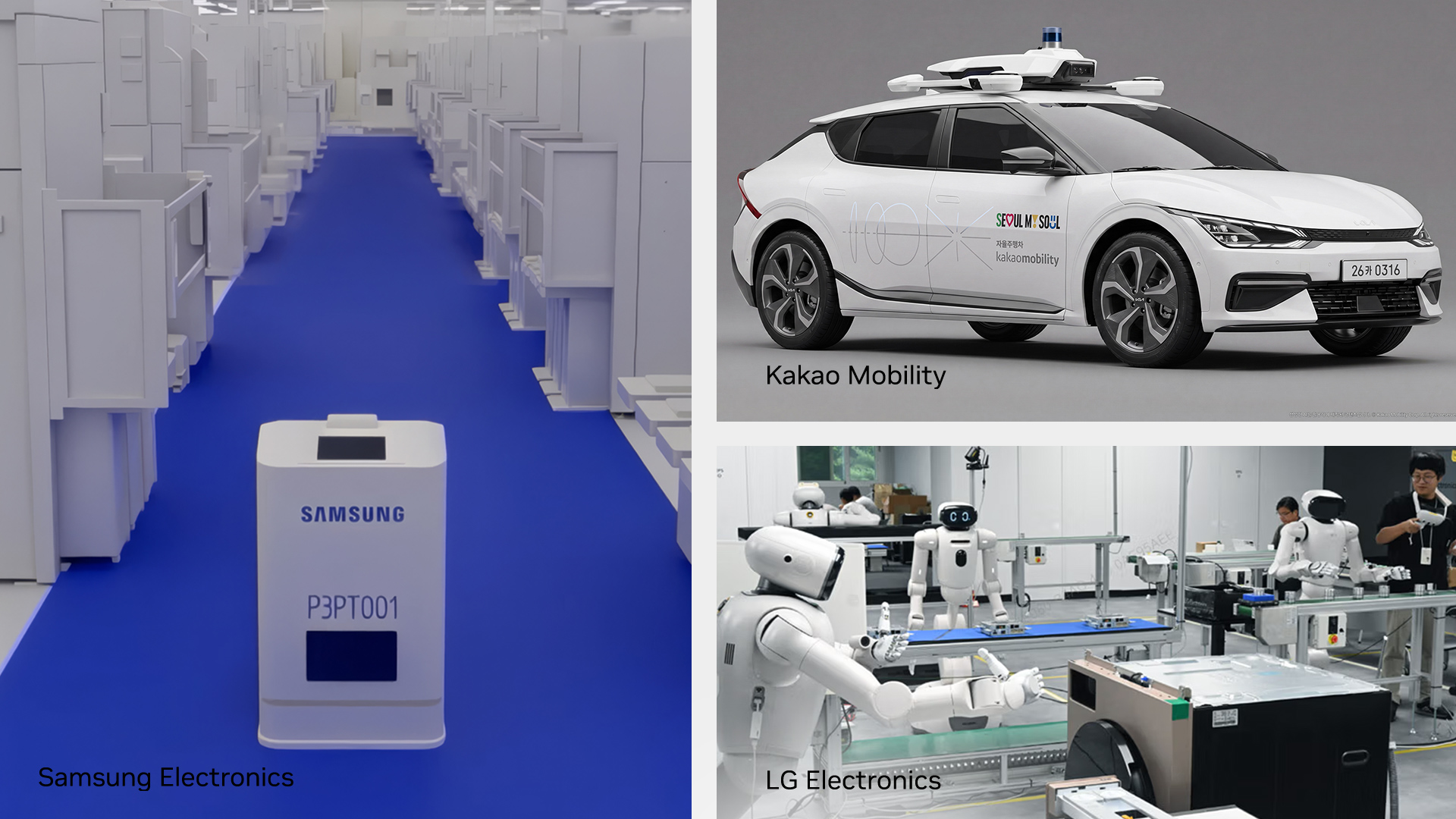
- Kakao Mobility plans to build a level 4 autonomous driving system using NVIDIA Hyperion and Halos, with initial development on Kia purpose-built vehicles.
- NVIDIA and LG Electronics demonstrated NVIDIA Isaac GR00T-powered robotic manipulation with LG's CLOiD robot in a manufacturing environment.
NVIDIA is expanding its AI collaborations across South Korea, tying accelerated computing, simulation and secure agent runtimes to the country's semiconductor manufacturing, mobility and robotics industries.
The combined efforts, spanning Samsung Electronics, Hyundai Motor Group, LG AI Research, LG Electronics, Kakao Mobility and AI security firm AIM Intelligence, aim to move physical AI and autonomous agents from development into production environments.
The push builds on the country's established strengths in manufacturing and engineering, with NVIDIA positioning its open models, datasets and runtimes as the connective layer for enterprise deployments.
Secure Agent Runtimes Anchor Enterprise Adoption
Hyundai Motor Group is exploring NVIDIA NemoClaw blueprints and the NVIDIA OpenShell runtime, while AIM Intelligence is integrating its Starfort agent control platform with OpenShell to support secure AI agents for employee productivity and enterprise workflows.
OpenShell, a key component of the NVIDIA Open Agent Safety Platform, provides a secure runtime with sandboxed execution and policy-based controls to safeguard sensitive data, manage access to enterprise tools and govern autonomous agent actions.
AIM Intelligence is also considering a preliminary proof of concept for the public energy sector, with potential applications across enterprise, industrial and robotics environments. The integration combines OpenShell's runtime access controls with Starfort's detection of malicious instructions and data leakage.
On the model side, LG AI Research is opening application programming interface access for K-EXAONE-2.5, developed using NVIDIA Nemotron datasets, including Nemotron-Personas-Korea. That dataset is an open collection of 7 million fully synthetic Korean personas, grounded in official Korean statistics, which model builders use to ground training data and evaluation in Korean contexts.
NVIDIA Nemotron itself is a family of open models, datasets and techniques intended to help developers build specialized, efficient AI agents.
Samsung Ties AI Physics to Semiconductor Engineering
Samsung Electronics is expanding its collaboration with NVIDIA to advance semiconductor innovation through accelerated computing and AI physics, spanning materials research, process development and device engineering.
In technology computer-aided design, Samsung is working with NVIDIA cuISS and NVIDIA cuDSS to accelerate computations involving sparse linear systems, extending the collaboration to GPU acceleration for process and optical simulations.
In materials research, Samsung's sMOL platform has run selected quantum chemical calculations up to 5x faster end to end with NVIDIA cuEST, while the company is exploring NVIDIA cuEquivariance to speed up tensor operations used in training and inference for atomistic AI models.
Samsung is also developing chip-scale thermal and mechanical analysis workflows with NVIDIA PhysicsNeMo. In one AI homogenization case, combining AI-predicted effective material properties, coarser grids and GPU acceleration produced a roughly 1,600x speedup, cutting simulation time from about 18 hours for a fine-grid solve on a 32-core CPU to 41 seconds for a GPU-accelerated coarse-grid solve.
Looking ahead, the NVIDIA Agent Toolkit could connect these simulation tools and AI models, helping future engineering agents run analyses and compare design options.
Mobility and Robotics Move Toward Production
Kakao Mobility plans to build on NVIDIA's autonomous vehicle computing and safety technologies to advance development of a level 4 autonomous driving system, combining its proprietary driving software and operating experience in Seoul's Gangnam district with NVIDIA's vehicle computing platform.
The company plans to use NVIDIA Hyperion, a reference platform for vehicle sensors and compute powered by NVIDIA DRIVE AGX Thor, along with NVIDIA Halos to support safety across development and validation.
Initial development is planned around Kia purpose-built vehicles, integrating Kakao Mobility's autonomous driving software with NVIDIA technologies, with the effort aimed at supporting future level 4 mobility services in Korea.
In robotics, NVIDIA and LG Electronics demonstrated NVIDIA Isaac GR00T-powered robotic manipulation and manufacturing tasks using LG's CLOiD robot in an actual manufacturing environment.
The collaboration implemented a physical AI data flywheel connecting real-world data collection, NVIDIA Cosmos-based data augmentation, GR00T model training, NVIDIA Jetson AGX Thor onboard computing and simulation-based evaluation, establishing reusable workflows for continued development and validation of CLOiD's robotic capabilities.
The teams are using this work to refine a repeatable process for training, evaluating and improving robots for manufacturing.
Editorial FAQs
What is NVIDIA OpenShell?
NVIDIA OpenShell is a secure runtime with sandboxed execution and policy-based controls that safeguards sensitive data, manages access to enterprise tools and governs autonomous agent actions. It is a key component of the NVIDIA Open Agent Safety Platform.
What is K-EXAONE-2.5?
K-EXAONE-2.5 is an AI model developed by LG AI Research using NVIDIA Nemotron datasets, including Nemotron-Personas-Korea. LG AI Research is opening application programming interface access for it.
How is Samsung using NVIDIA technology?
Samsung Electronics is expanding its collaboration with NVIDIA to advance semiconductor innovation through accelerated computing and AI physics. This includes using NVIDIA cuISS, cuDSS, cuEST, cuEquivariance and PhysicsNeMo for materials research, process development and device engineering.
What is Kakao Mobility's plan for autonomous driving?
Kakao Mobility plans to build a level 4 autonomous driving system using NVIDIA Hyperion and NVIDIA Halos. Initial development is planned around Kia purpose-built vehicles, integrating Kakao Mobility's autonomous driving software with NVIDIA technologies.