Staera Semiconductor raised US$4.6 million to commercialize Lightwire, an optical interconnect that integrates GaN LEDs, CMOS circuits and silicon nitride waveguides directly into silicon chips. Commercial release is targeted for 2030.
Key metrics
TB/s Lightwire HBM Target24
Key takeaways
Staera Semiconductor raised US$4.6 million in pre-seed funding led by Openspace Capital, with SGInnovate, Black Kite Capital, 28 Holdings, In Group and Decimus Technologies participating.
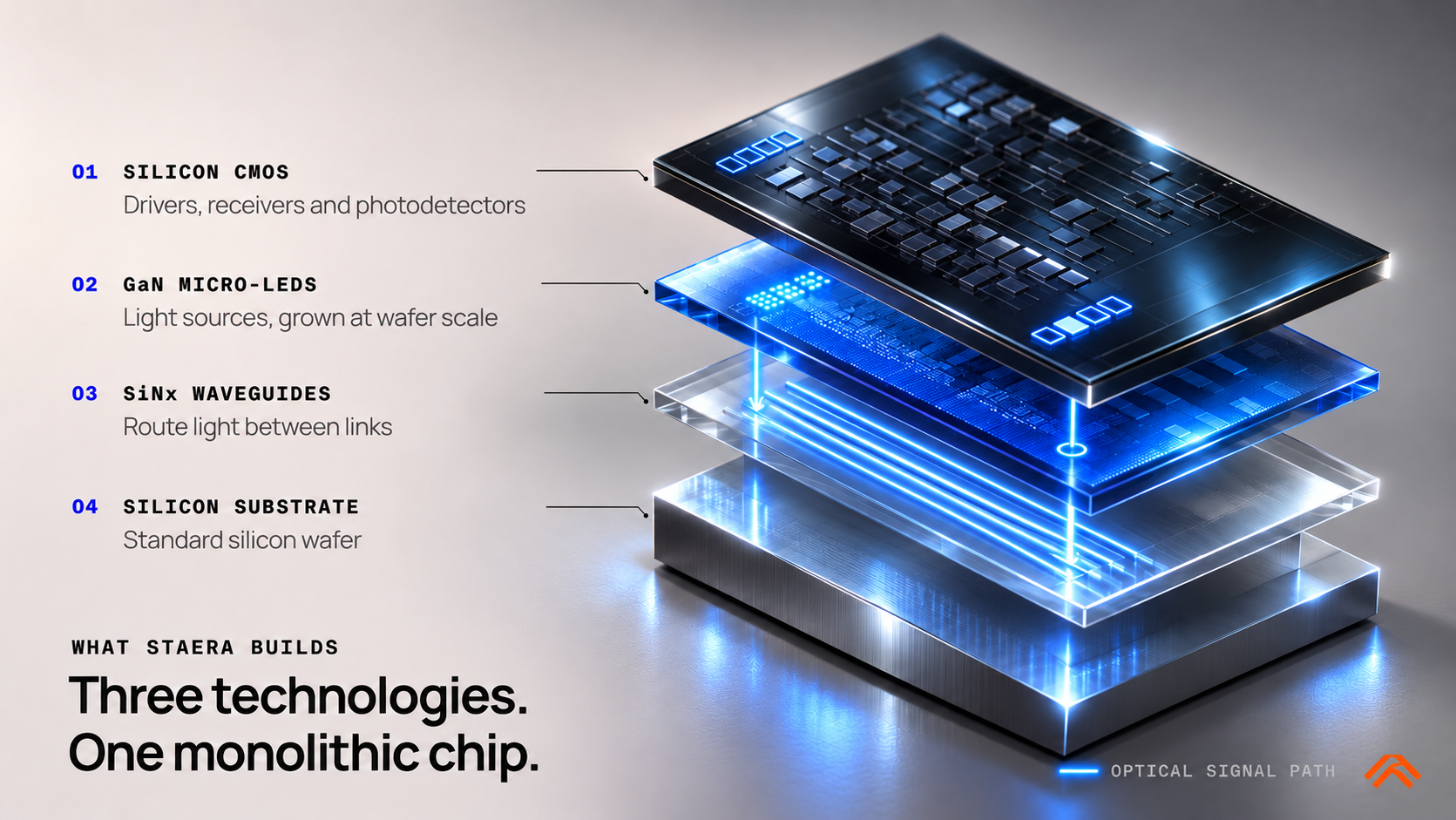
Lightwire builds the entire optical link, including GaN LEDs and waveguides, inside commercial silicon wafers rather than attaching optics next to the chip.
Staera says Lightwire is designed for under 0.2 pJ/bit, against 5 pJ/bit for co-packaged optics, and can move 24 TB/s in under 50 watts.
The company has built GaN LEDs into silicon chips in commercial foundries since 2016, with processes now running at 98 to 99 percent yield.
Staera targets commercial release in 2030 and will use the funding to expand its team into the US and deepen customer and supply chain engagement.
Staera Semiconductor has emerged from stealth with US$4.6 million in pre-seed funding to commercialize Lightwire, an optical interconnect designed to move data between AI chips without the power and heat costs associated with longer copper connections.
Formerly known as New Silicon Corporation, the Singapore-based company said the round was led by Openspace Capital, with participation from SGInnovate, Black Kite Capital, 28 Holdings, In Group and Decimus Technologies.
Lightwire places the complete optical link inside the silicon chip rather than attaching separate lasers, LEDs or optical components alongside it. The company is targeting AI infrastructure, where data movement between processors, memory, boards and racks is becoming a constraint as computing performance increases. Commercial release is targeted for 2030.
Staera Raises US$4.6M to Build Optical Links Into AI ChipsExecutive Strategy and Commercial Transition
Staera said the funding will support technology development, expansion of its team into the US, and deeper engagement with customers and supply-chain partners. The company’s approach is intended to fit existing AI hardware packaging by building Lightwire into the bridge or interposer chip that connects processors and memory.
AI's bottleneck is no longer how fast chips compute, but how fast and far they can move data. Copper performance plummets over the millimeter
—Dr Andrew Kim, Chief Executive Officer, Staera
The company’s announcement cited International Energy Agency estimates that data center electricity consumption could rise from about 415 terawatt-hours in 2024 to around 945 terawatt-hours by 2030.
It also pointed to a shift toward hybrid connectivity in AI systems: Nvidia said in 2025 that it would “stay with copper for as long as [they] can,” while planning to use both copper and optical links.
Integrated Architecture and Performance Targets
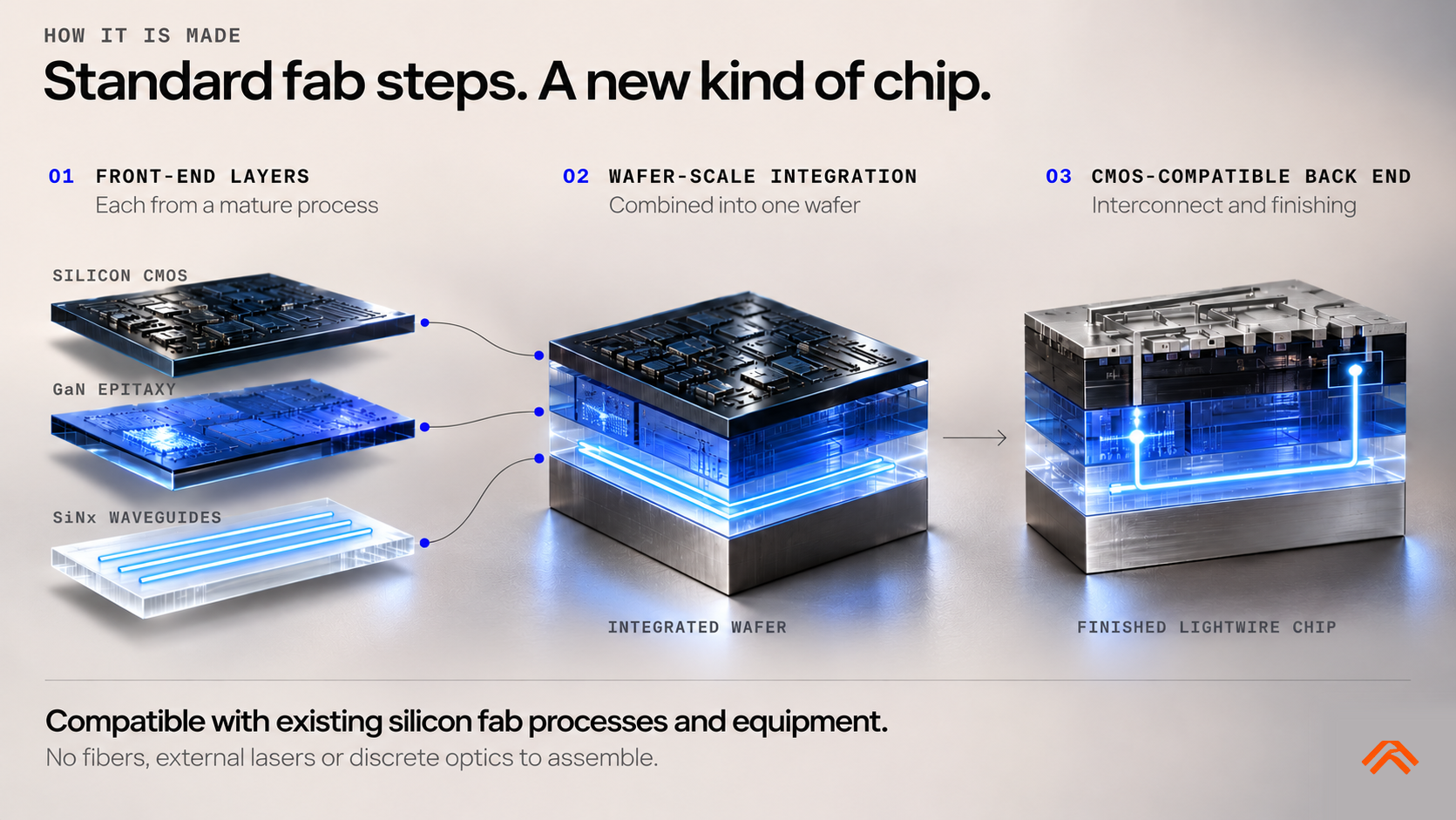
Lightwire combines three elements on a single silicon wafer: silicon CMOS circuits, gallium nitride (GaN) LED light sources and silicon nitride waveguides that route light between links. Staera says the manufacturing process uses standard fabrication steps and is designed to run in existing commercial fabs without adding chip size, heat or power. The company has built GaN LEDs into silicon chips in commercial foundries since 2016, with processes now running at 98 to 99 percent yield.
Staera Raises US$4.6M to Build Optical Links Into AI ChipsThe links are specified at 4 to 8 Gbps per link, with more than 600 links per millimeter of chip edge. Staera says Lightwire is designed to use less than 0.2 pJ/bit, compared with 5 pJ/bit for co-packaged optics, and to deliver more than 100 times the performance of electrical links across the millimeter-to-meter range. The company also says the technology can reach beyond 50 mm, compared with 2 mm for UCIe-A die-to-die links.
For system architects, the company’s stated power comparison is a key design claim. Moving 24 terabytes of data per second would require under 50 watts with Lightwire, compared with nearly one kilowatt using co-packaged optics. Lightwire-based high-bandwidth memory is designed to exceed 24 TB/s, compared with 2.8 TB/s per HBM4 stack today. These figures are company targets and comparisons supplied in Staera’s announcement.
Singapore Origin and 2030 Rollout
The pre-seed round marks Staera’s transition from research toward a commercial product. The company said it will expand its US presence while continuing work with customers and supply-chain partners before the targeted 2030 release.
Staera is addressing one of AI infrastructure’s most urgent challenges: moving vast amounts of data between chips without a corresponding rise in power, heat and complexity. Its ability to build optical links directly into silicon offers a compelling path to faster, more efficient, and more scalable AI systems. We backed Staera because of the strength of its technology, the depth of its team and its potential to define a new category in semiconductor connectivity.
—Hian Goh, Co-Founder, Openspace Capital
Staera began as a spin-off from the Low Energy Electronic Systems interdisciplinary research group at the Singapore-MIT Alliance for Research and Technology. In May 2026, it won the third ECTC Start-up Competition at the IEEE Electronic Components and Technology Conference and placed runner-up at the 2026 Lam Capital Venture Competition in Fremont, California. The company’s rollout plan now centers on moving Lightwire from laboratory development into customer engagement and eventual commercial production.
AI InfrastructureAI energy efficiencyAI-ready infrastructureAISemiconductorsManufacturing, Supply Chain & LogisticsTelecommunications & ConnectivitySoutheast Asia / ASEAN
What is Staera Semiconductor's Lightwire technology?
Lightwire is an optical interconnect that builds the light source and every other part of a complete optical link inside commercial silicon wafers. It combines silicon CMOS circuits, GaN LED light sources and silicon nitride waveguides on one chip to replace copper links between chips, boards and racks.
How much did Staera Semiconductor raise and who led the round?
Staera raised US$4.6 million in pre-seed funding led by Openspace Capital, with participation from SGInnovate, Black Kite Capital, 28 Holdings, In Group and Decimus Technologies.
When will Lightwire be commercially released?
Staera is targeting commercial release in 2030. The pre-seed funding will be used to advance the technology, expand the team into the US, and deepen engagement with customers and supply chain partners.
Where did Staera Semiconductor come from?
Staera, formerly New Silicon Corporation (NSC), began as a spin-off from the Low Energy Electronic Systems (LEES) interdisciplinary research group at the Singapore-MIT Alliance for Research and Technology (SMART).