Singapore's First AI-Assisted Robotic Car Wash
Three robotic units handle foam and rinse while trained detailers retain hand wash, dry and double inspection.
November 10, 2026 · 3 min read
Executive summary
Lambency Detailing launches Singapore's first AI-assisted robotic car wash across Ubi and Bukit Batok, pairing automated foam and rinse with mandatory hand detailing.
Key takeaways
- Automation as capacity, not replacement: Lambency's model redeploys staff time to judgment-heavy tasks such as spotting stone chips and tar, rather than cutting headcount — a template for labour-constrained service SMEs weighing AI adoption.
- Human oversight is the differentiator in trust-sensitive categories: the company retains a hand wash and two inspections per vehicle, signalling that customer-facing AI deployments must protect quality control where physical assets or safety are at stake.
- Efficiency gains are measurable and customer-visible: automated stages roughly halve foam-and-rinse time, directly compressing service wait times without changing the price point — a rare case of AI adoption absorbed at no cost to the end customer.
- Water use is the under-examined cost line: manufacturer figures cite roughly 60 litres per vehicle versus 100 litres or more manually, yet no recycling is installed, implying resource efficiency — not closed-loop sustainability — is the near-term benefit.
- Adoption is spreading beyond early movers: IMDA's 2026 Digital Economy Report tracks SME AI use rising from 14.5% in 2024 to 23.4% in 2025, suggesting operational AI is moving from pilot to standard practice in Singapore's SME base.
Fancy your car being washed and groomed by robots? You can now have that done in Singapore.
Lambency Detailing, a Singapore car detailing and grooming company established in 2017, has introduced AI-assisted car washing at its Ubi and Bukit Batok outlets, becoming the first business in Singapore to deploy the system after a brief trial.
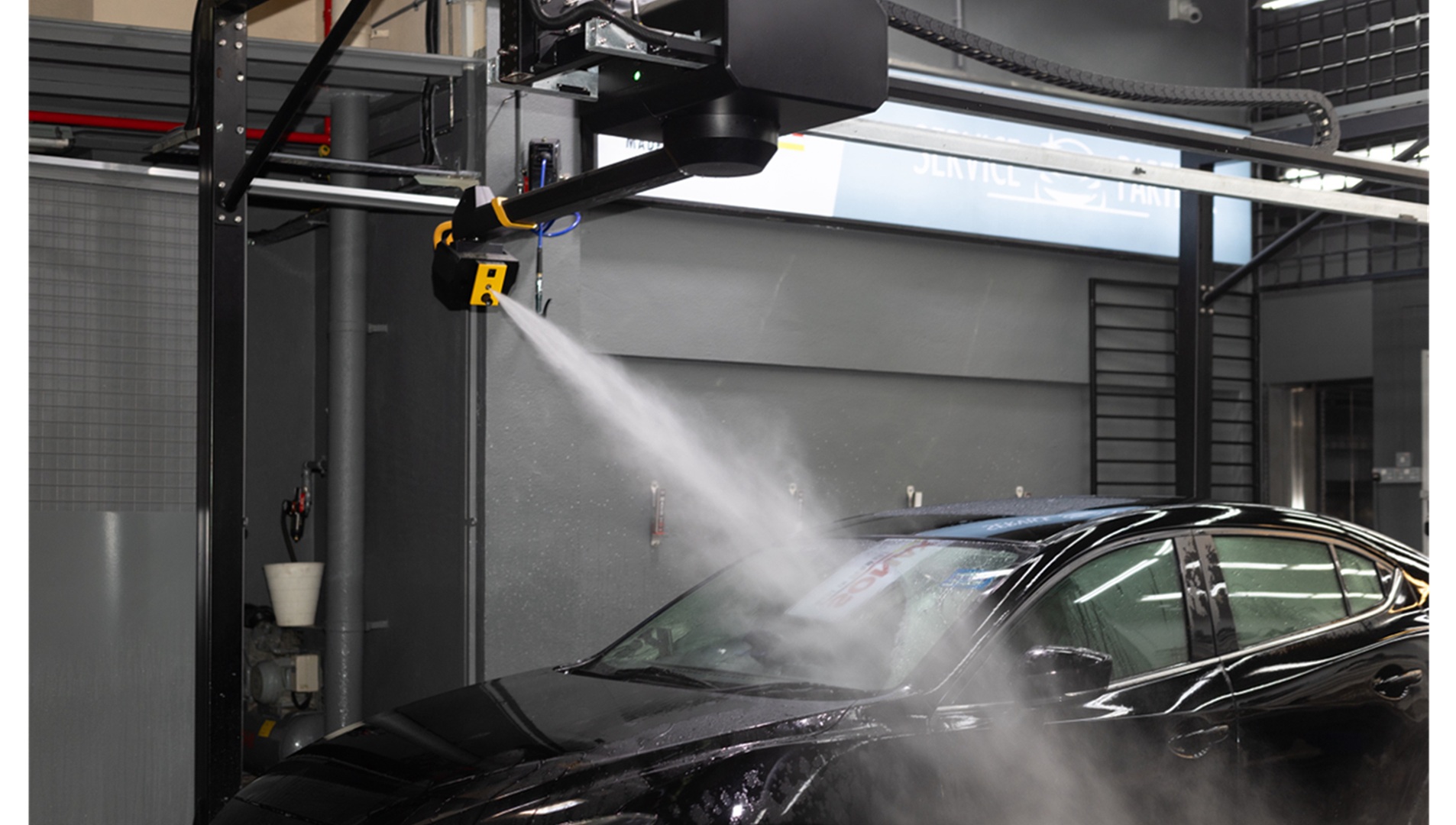
Three robotic units, installed in September 2026 and refined through trial runs, now handle the foam and rinse stages of every wash, while the company's trained detailers continue to wash each vehicle by hand, dry it and inspect it before handover.
How the Robotic Wash System Operates
Before the machine starts, a detailer guides the vehicle into the bay and inspects it. Using computer vision and 3D modelling, the robotic arm recognises the vehicle's shape, size and position, plans its own cleaning path and applies foam and a high-pressure rinse, adjusting its angle and water pressure for each part of the body.
The automated stages are touchless: only water and foam reach the paintwork, and the system uses no brushes or cloth strips. Detailers then wash the vehicle by hand, the unit carries out a final rinse, and staff dry the car and inspect it once more before handover.
According to the manufacturer, the system uses approximately 60 litres of water per vehicle, compared with 100 litres or more for a manual car wash, and no water recycling is used in this installation.
Each unit is a twin-track robotic wash arm developed by an international robotics manufacturer whose systems operate at approximately 6,000 sites worldwide; the model is CE and UL certified, and the manufacturer holds a portfolio of more than 100 patents.
For customers, the result is a more consistent wash and a shorter wait, as the automated stages take roughly half the time of a manual foam and rinse. The AI-assisted wash is offered as Lambency's SONAX Car Wash at the existing price of S$35 for small to large cars and S$45 for extra-large and exotic vehicles.
Human Detailers Freed for Judgment-Led Work
For a business entrusted with customers' paintwork, the challenge is to capture productivity and quality gains without giving up human oversight.
The company frames the automation as a reallocation of labour rather than a substitution.
The machine is very good at the parts of a wash that should be the same every time: the foam, the rinse and the coverage. What it cannot do is notice a stone chip on a bumper or tar spots behind a wheel arch. Our detailers can, and that is why every car still gets a hand wash and two inspections.We are using technology to give our team more time for the work that needs their judgement, not to take them out of the process.Matthew Lim, Director, Lambency Detailing
Sensible Way for SMEs to Leverage AI
The move reflects a wider shift towards AI among Singapore's small and medium-sized enterprises. According to the Infocomm Media Development Authority's Singapore Digital Economy Report 2026, AI adoption among SMEs rose from 14.5% in 2024 to 23.4% in 2025.
Lambency claims itself as the first SONAX Preferred Detailing Partner in Southeast Asia. The new wash process sits alongside its existing detailing services, including SONAX and GTECHNIQ ceramic coating, paint protection film and interior detailing.
Lambency has built its name on careful hand work, and this is a sensible way to use technology: the machine takes the repetitive stages while trained hands and eyes stay on every car.Davin Neo, SONAX Master Trainer
Over the next 12 to 24 months, Lambency plans further technology investments that free its detailers more time for the work customers come to them for.
Editorial FAQs
What is Singapore's first AI-assisted robotic car wash?
It is a system launched by Lambency Detailing at its Ubi and Bukit Batok outlets, using computer vision and 3D modelling to recognise a vehicle's shape, size and position, plan a cleaning path and apply touchless foam and high-pressure rinse.
Does the robotic car wash replace human detailers?
No. According to Lambency director Matthew Lim, the machine handles the repeatable foam, rinse and coverage stages, while trained detailers wash each vehicle by hand, dry it and perform two inspections.
How much water does the AI-assisted car wash use compared with a manual wash?
According to the manufacturer, the system uses approximately 60 litres of water per vehicle, against 100 litres or more for a manual car wash. No water recycling is used in this installation.