AI Adoption Spreads Across APAC Small Businesses
A YouGov study commissioned by Meta finds broad AI adoption among small businesses, alongside demand for clearer training, cost and security guidance.
Key takeaways
- Meta-commissioned YouGov research surveyed 3,983 small business owners across nine APAC markets between 6 August and 2 September 2026.
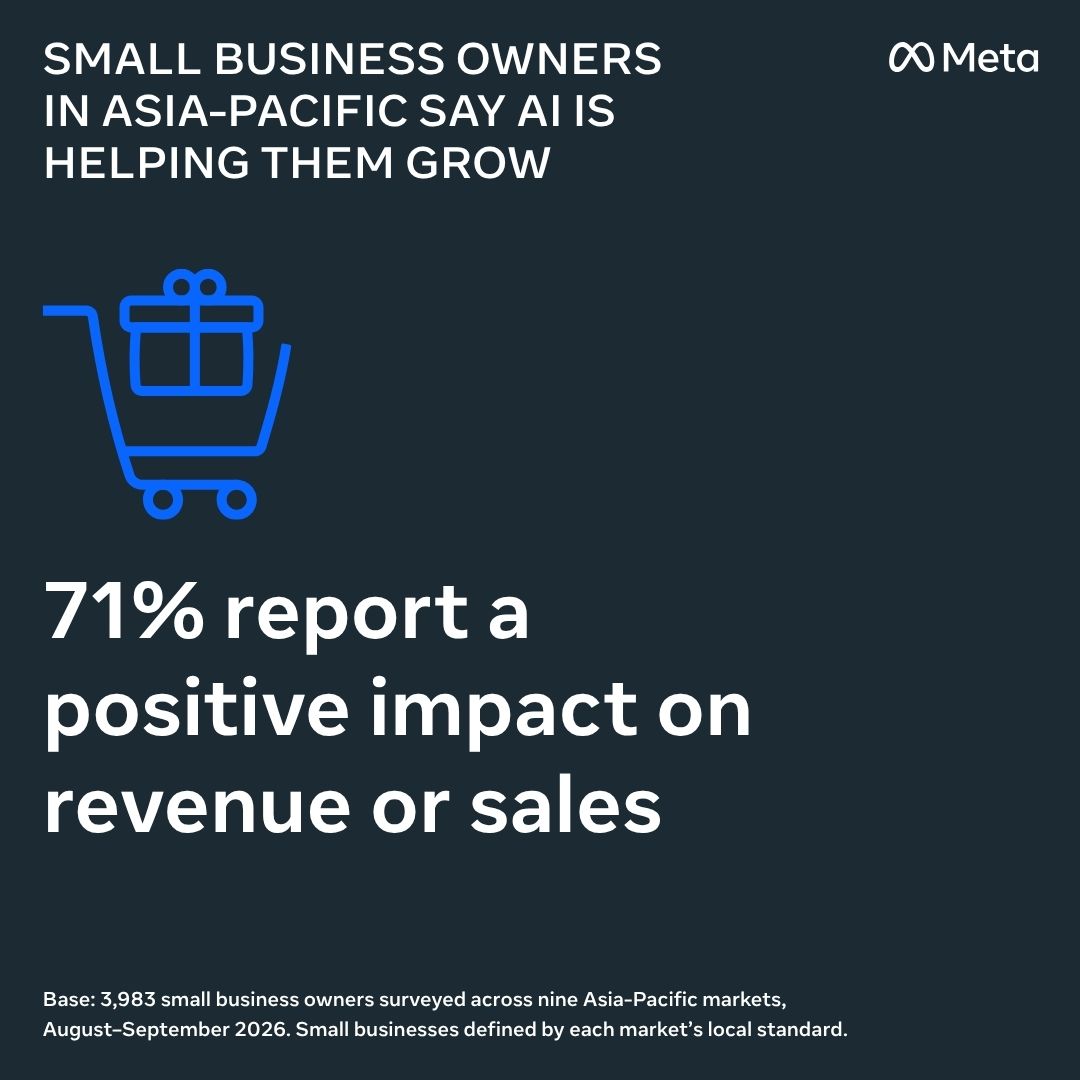
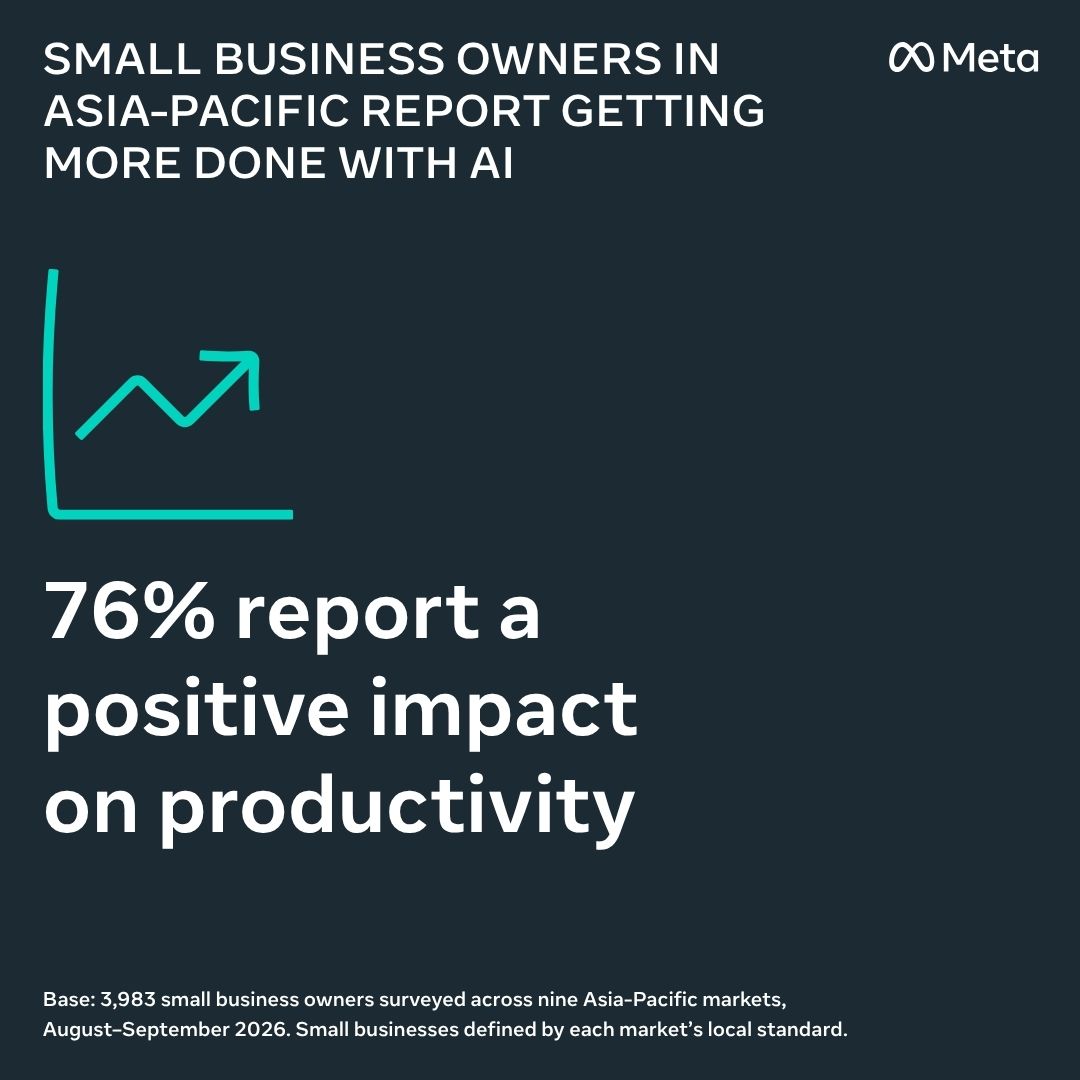
- 84% of surveyed owners currently use AI, 76% report a positive productivity impact and 71% a positive revenue or sales impact.
- 86% say small businesses need more guidance to gain the full benefits of AI, with cost cited by 51% as the leading barrier to training.
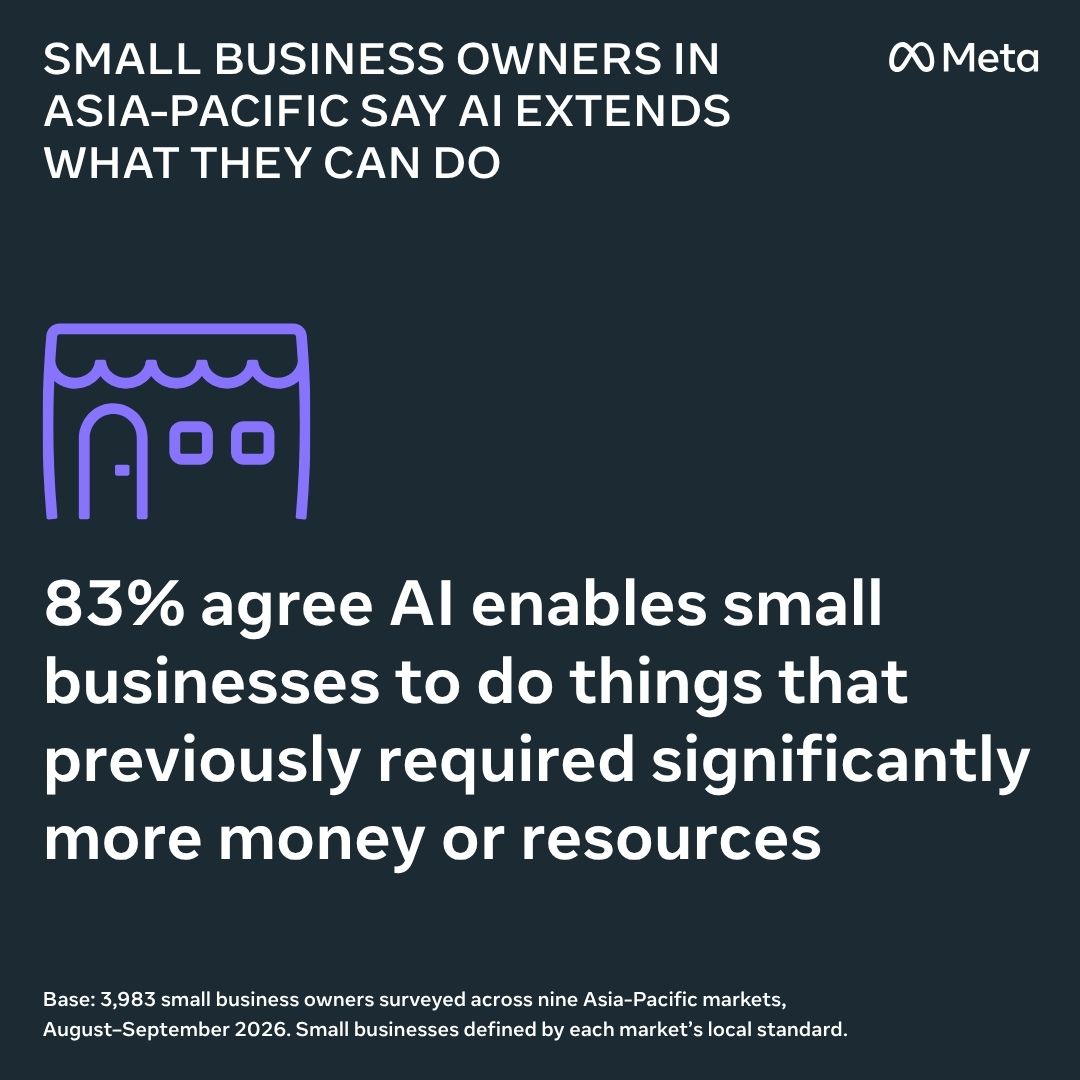
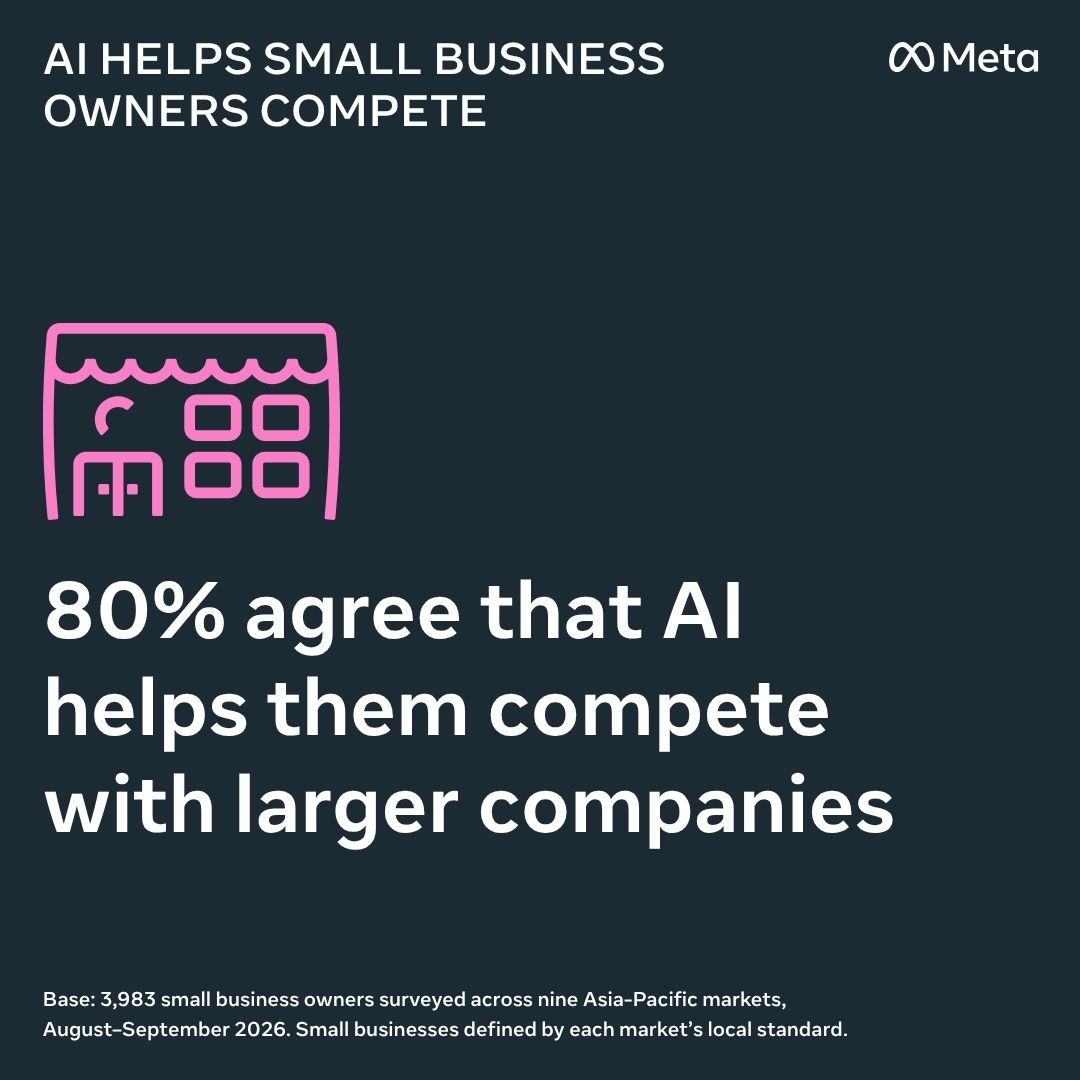
- 80% agree AI helps small businesses compete more effectively with larger companies, and 83% say it enables things that previously required more money or resources.
- In Indonesia, Zayya founder Husnul Khotimah expanded into Malaysia on a daily ad budget of Rp30,000 (USD1.68), generating 50 enquiries and more than eight times return on ad spend.
For small business owners across Asia-Pacific, the immediate value of artificial intelligence is being measured in saved time, customer enquiries and the ability to reach markets that once required significantly greater resources. New research commissioned by Meta and conducted by YouGov found that 84% of surveyed owners are currently using AI, while 76% reported a positive impact on productivity and 71% reported a positive impact on revenue or sales over the past 12 months.
The findings also point to a gap between adoption and capability. Although AI use is already broad across the nine markets surveyed, 86% of owners said small businesses need more guidance to gain its full benefits. Cost was the leading barrier to training, cited by 51% of respondents. The results suggest that many smaller companies are moving beyond the question of whether to use AI and toward practical questions about training, return on investment, data privacy and security.
Adoption Is Broad, but Guidance Remains Limited
The research surveyed 3,983 small business owners in Australia, Singapore, Vietnam, Indonesia, Taiwan, India, Thailand, Japan and Hong Kong. Data was collected online between 6 August and 2 September 2026. Within each market, YouGov applied quotas by business size to create a broad and balanced spread across companies with 1–9, 10–19 and 20–49 employees.
The findings are not nationally representative of the small business population in each market. Meta said reported adoption and impact differ across the nine markets, with those differences potentially reflecting how owners interpret questions, as well as translation and local survey response norms. Even with those limitations, the results provide a cross-market view of how small businesses describe their current use of AI.
Four in five respondents, or 80%, agreed that AI helps small businesses compete more effectively with larger companies. The same proportion said AI makes starting a business easier, while 83% agreed that it enables small businesses to do things that previously required significantly more money or resources.
The productivity impact was most often connected to how owners redeploy time. Among respondents who reported a positive productivity impact from AI, 58% said they were using the time to improve the quality of existing work, 50% were putting it into growth and business planning, and 46% were getting more done with their existing teams.
From Content Creation to Customer Support
The most common applications remain closely tied to everyday commercial work. Among surveyed owners whose businesses had used AI in the previous 12 months, 51% had used it to create or edit content. Another 43% used it for local advertising and marketing, 38% for translation, and 37% for customer support and communications.
Those use cases reflect the constraints identified in the research: limited resources and limited time. AI is being applied to activities that can affect customer acquisition, communications and internal productivity without requiring a separate specialist function. The survey does not establish that AI caused the reported revenue or sales effects, but 71% of owners said they experienced a positive impact on revenue or sales over the past year.
The next challenge is implementation quality. Owners said they would value clearer information about cost and return on investment, alongside guidance on data privacy and security. The research also points to demand for free training and policies that support access to AI and investment in digital skills.
Meta’s Training Programme and Business Tools
The research follows Meta’s launch of the Small Business Growth Academy across Asia-Pacific earlier in 2026. The programme is designed to help small businesses use digital and AI-enabled tools to find customers, improve productivity and grow across borders. It is delivered with governments, chambers of commerce and local programme partners.
Training covers AI-enabled advertising, Reels, WhatsApp for Business and cross-border commerce. Meta also identifies several tools that small businesses can use, including Advantage+ for creating and running ads, ads that click to WhatsApp to turn conversations into customer discussions, and Meta Business Agent to handle customer enquiries automatically.
The programme’s focus reflects the survey’s central finding: adoption alone does not resolve questions about effective use. Owners are asking for practical instruction on the relationship between spending and returns, as well as safeguards around business data and customer interactions.
A Case from Indonesia
The experience of Husnul Khotimah, founder of Indonesian modest fashion brand Zayya, illustrates how the tools and training are being applied in one business. After using Small Business Growth Academy training, Khotimah expanded into Malaysia with a daily advertising budget of Rp30,000, or USD1.68.
Using Meta’s business tools, Zayya generated 50 enquiries and reduced customer response times from between 30 and 60 minutes to under two minutes. Khotimah reported more than eight times return on ad spend for the campaign. The figures are reported by the business and describe a single campaign rather than a benchmark for the wider survey population.
Meta has helped me see what is possible for a small business like Zayya. I used to think AI was mainly for writing captions and creating content, but I’ve learned that it can also help me understand new markets and reach the right customers. Using tools like Advantage+, we’ve been able to reach customers beyond Indonesia with a small advertising budget, while giving me more time to grow the business and connect with more women who share the same needs that inspired Zayya in the first place.
Her account combines several themes identified in the research: content and advertising use, cross-border expansion, reduced response times and the redeployment of saved time toward growth. It also shows why training is a material part of adoption for smaller companies, rather than a separate issue after deployment.
The Enterprise Playbook for Smaller Firms
The survey results point to a practical sequence for small businesses assessing AI. First is identifying activities where time or resource constraints are most visible, such as content production, marketing, translation and customer communications. The next step is establishing how performance will be assessed, particularly where owners are seeking clarity on cost and return on investment.
Data privacy and security are equally prominent in the support requested by respondents. Those considerations are relevant to tools that handle advertising, customer enquiries and business communications, although the source material does not specify particular security controls or compliance frameworks. The findings therefore support a demand for guidance rather than a conclusion that all deployment risks have been resolved.
Meta’s Small Business Growth Academy is positioned as one response, with training delivered through public-sector, business and local programme partners. The research indicates that the wider requirement is broader than access to individual tools: owners want free training, clearer information about costs and returns, and policies that support digital skills and AI investment.
For APAC’s small businesses, the central transition is from initial experimentation to repeatable operating practice. AI adoption is already reported by 84% of the surveyed owners, but the 86% seeking more guidance shows that usage has not eliminated uncertainty. The next phase will depend on whether businesses can connect specific AI applications to measurable productivity, sales and customer-service outcomes while addressing the training, privacy and security questions that accompany wider use.